
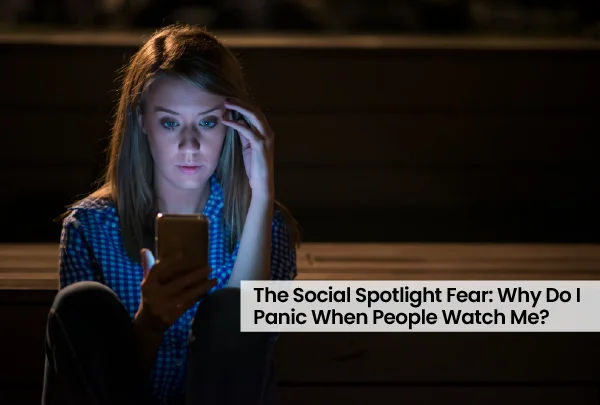
Have you ever been asked to speak in a meeting and felt your heart race? Or become unusually conscious of your appearance, words, or actions when people are looking at you? Perhaps you rehearse conversations beforehand, worry about making mistakes, or replay an ordinary interaction in your mind long after it has ended.
This experience is often connected to the social spotlight effect, the feeling that everyone is noticing, observing, and judging you, even when most people are actually focused on themselves.
While occasional nervousness is normal, constantly feeling watched can affect confidence, relationships, education, and professional life. So, why does this happen, and how can you stop feeling as though you are always under a spotlight?
What Is the Social Spotlight Effect?
A psychological phenomenon known as the “social spotlight effect” causes people to exaggerate how much other people notice their look, behavior, errors, or actions.
Imagine entering a room and suddenly noticing a stain on your shirt. You may feel that everyone has noticed it, even though most people have not paid attention.
This occurs as a result of how we see the world. We are highly aware of our thoughts, feelings, and appearance, so we mistakenly assume that others are equally attentive to us.
People tend to overestimate how much others notice their looks and behavior, according to research by Gilovich et al. (2000).
In simple terms, you may feel like the centre of everyone’s attention when, in reality, you are not.
Why Do I Panic When People Watch Me?
Feeling watched can activate the body’s natural threat response. Your brain may interpret social evaluation as a potential threat, triggering physical and emotional reactions.
Several factors can contribute to this experience:
1. Fear of Being Judged
You can be preoccupied with what other people think of you all the time. Thoughts like “What if I say something stupid?” or “What if they laugh at me?” can create intense nervousness.
2. Low Self-Confidence
When you doubt your abilities or appearance, you may become excessively conscious of how others perceive you. Even a small mistake can feel like evidence that you are inadequate.
3. Previous Embarrassing Experiences
Being criticised, bullied, laughed at, or humiliated can make future social situations feel unsafe. Your mind may begin anticipating similar experiences, even when there is no actual threat.
4. Perfectionism and Overthinking
People who expect themselves to perform perfectly may find ordinary interactions stressful. They might spend hours analysing conversations, worrying about their expressions, tone, or choice of words.
5. Social Anxiety
Sometimes, the fear of being watched goes beyond ordinary self-consciousness. It may be associated with social anxiety disorder, particularly when the fear of embarrassment or negative evaluation is persistent and interferes with everyday functioning.
What Takes Place in Your Body and Mind When You Feel Watched?
When you believe people are evaluating you, your nervous system may activate its fight-or-flight response.
You might experience:
- Rapid heartbeat and excessive sweating.
- Trembling hands or a shaky voice.
- Blushing or feeling unusually warm.
- Difficulty maintaining eye contact.
- Dry mouth or difficulty speaking.
- Racing thoughts or mental blankness.
- An overwhelming urge to leave the situation.
Psychologically, you may become excessively focused on yourself. Instead of listening to a conversation, you start monitoring your facial expressions, posture, voice, and movements.
This is known as self-focused attention. It can make social interactions more uncomfortable because you concentrate on how you appear rather than what is actually happening.
How Can You Stop Feeling Like Everyone Is Watching You?
The goal is not to become completely comfortable in every social situation. It is to understand that being noticed, making mistakes, or feeling nervous does not mean you are unsafe or inadequate.
Here are some practical strategies:
1. Challenge Your Assumptions
When you feel judged, pause and examine your thoughts.
Ask yourself:
- Do I have actual evidence that everyone is watching me?
- Am I assuming what other people are thinking?
- Will anyone remember this moment tomorrow?
- Would I judge someone else as harshly for making the same mistake?
For example, if you stumble over a word during a presentation, remind yourself that one imperfect sentence does not define your communication skills.
2. Shift Your Attention Outward
Instead of monitoring how you look or sound, focus on the people and environment around you.
Try listening carefully, asking genuine questions, noticing your surroundings, and concentrating on communicating rather than impressing others.
3. Practise Gradual Exposure
Avoiding uncomfortable situations may provide temporary relief, but it can strengthen fear over time.
Instead, gradually practise situations that make you nervous:
- Make brief eye contact with someone.
- Ask a question in a small group.
- Start a conversation with a colleague.
- Share your opinion during a discussion.
- Participate in a meeting or public-speaking activity.
Move at a manageable pace and acknowledge your progress.
4. Be Kinder to Yourself
You do not have to perform perfectly to deserve acceptance. Everyone makes mistakes and experiences awkward moments.
Replace harsh self-criticism with supportive statements such as:
- “It is okay to feel nervous.”
- “I do not need everyone’s approval.”
- “One awkward moment does not define me.”
- “I am allowed to be imperfect.”
5. Practise Mindfulness and Relaxation
Slow breathing, grounding exercises, and mindful awareness can help manage physical tension.
Try breathing gently through your nose, allowing your abdomen to expand, and slowly exhaling. Repeat for a few minutes without forcing your breath.
You can control your stress and return your focus to the here and now with the aid of these techniques.
When Should You Seek Professional Help?
Occasional nervousness does not necessarily indicate a psychological disorder. However, consider professional support if:
- You regularly avoid social gatherings, meetings, or public speaking.
- You have a severe fear of being judged or embarrassed.
- Physical symptoms interfere with everyday activities.
- You constantly replay conversations and criticise yourself.
- Your fear affects your education, career, or relationships.
Cognitive Behavioural Therapy (CBT) is an evidence-based approach that helps identify unhelpful thinking patterns, challenge negative assumptions, and gradually reduce avoidance behaviours.
If you are searching for a psychologist near me, consider consulting a qualified mental health professional who understands social anxiety and evidence-based psychological interventions. An expert psychologist in India can help you develop healthier coping strategies and improve your confidence.
Where Can You Get Professional Counselling Support?
If the fear of being observed is affecting your everyday life, professional guidance can help you understand its underlying causes and develop healthier responses.
If you are searching for counseling near me, Psychowellness Center offers psychological counselling and therapy services at its Delhi branches:
- Janakpuri Branch: A Block, Janakpuri, Delhi.
- Dwarka Branch: Sector-17, Dwarka, Delhi.
- Contact: 09810636188, 07827208707.
You can also explore online counselling through TalktoAngel, which offers video, audio, and chat-based support from the comfort of your home.
Conclusion
Feeling watched or judged can make ordinary interactions exhausting. However, remember that people are usually much more occupied with their own thoughts and concerns than you imagine. You do not have to impress everyone, avoid every mistake, or constantly monitor your behaviour to feel accepted.
With self-awareness, gradual practice, and appropriate professional support, you can learn to manage social fears and participate in everyday situations with greater confidence.
Psychowellness Center provides professional psychological counselling and therapy services in Janakpuri and Dwarka, Delhi. TalktoAngel extends accessible online counselling through video, audio, and chat sessions, helping individuals seek support from wherever they feel comfortable.
Take the first step towards feeling more confident and less self-conscious. Reach out to a qualified mental health professional and allow yourself to live beyond the fear of being watched.
Frequently Asked Questions
Is being afraid of people watching me a sign of social anxiety?
Not necessarily. Occasional nervousness is normal. However, persistent fear of judgement that interferes with daily life may indicate social anxiety.
Why do I feel like everyone notices my mistakes?
This may be related to the spotlight effect, where you overestimate how much attention others pay to your behaviour and appearance.
Can social anxiety be treated?
Yes. Evidence-based treatments, particularly CBT, can help manage negative thinking patterns, reduce avoidance, and improve social confidence.
How can I become more confident around people?
Start with small social interactions, challenge negative assumptions, practise self-compassion, and gradually participate in situations that make you uncomfortable.
Contributed by: Dr. R.K. Suri, Clinical Psychologist, and Ms. Tanu Sangwan, Counselling Psychologist
References
Gilovich, T., Medvec, V. H., & Savitsky, K. (2000). The spotlight effect in social judgment: An egocentric bias in estimates of the salience of one’s own actions and appearance. Journal of Personality and Social Psychology, 78(2), 211–222. https://doi.org/10.1037/0022-3514.78.2.211
National Institute of Mental Health. (n.d.). Social anxiety disorder: What you need to know. https://www.nimh.nih.gov/health/publications/social-anxiety-disorder-more-than-just-shyness
National Institute for Health and Care Excellence. (2013). Social anxiety disorder: Recognition, assessment and treatment (CG159). https://www.nice.org.uk/guidance/cg159
https://www.psychowellnesscenter.com/service-anxiety-treatment-delhi/
https://www.psychowellnesscenter.com/service-phobia-treatment-in-delhi/
https://www.psychowellnesscenter.com/Blog/social-anxiety-when-fear-of-judgment-disrupts-daily-life/