
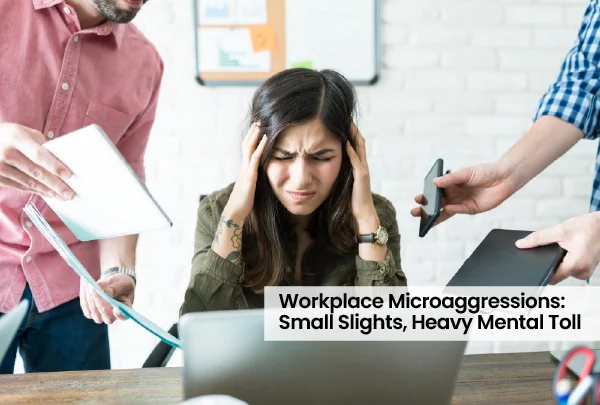
A colleague tells you you’re “surprisingly articulate.” Your manager keeps getting your name wrong. Your idea is ignored in a meeting, then praised when someone else repeats it. None of this would make a formal complaint, yet you replay it at night. These moments are workplace microaggressions, and they add up. This guide explains what they are, how they affect your mind and performance, and what you can do about them, from daily habits to professional support.
What Are Workplace Microaggressions?
Microaggressions are brief, often unintentional comments or behaviours that signal disrespect toward someone’s identity. The workplace is one of the most common places people report them.
Common examples include:
- Remarks about someone’s accent, region, religion or surname
- “You’ll be getting married soon, so we’ll hold off on that project”
- Comments on age, such as “too young to lead” or “too old to learn”
- Dismissing a concern as “being dramatic” or “too sensitive”
- Interrupting or talking over the same person repeatedly
How Do Microaggressions Affect Mental Health?
Research links them to real psychological costs. A study of 325 sexual minority employees connected workplace microaggressions to lower job satisfaction, higher job stress, and more symptoms of depression, anxiety and stress. A UK survey of Black psychiatrists found that 57.8% had faced workplace microaggressions, and 43.1% reported a harmful effect on their mental health.
These effects aren’t limited to minority groups. A five-day diary study found that microaggressions can trigger negative emotions at work that, in turn, reduce vitality and mental health, and that this can happen to employees in general.
The result is professional pressure and strain that doesn’t come from your workload at all. It comes from staying alert to the next small slight.
What Are the Warning Signs?
- Dreading meetings with certain people
- Rehearsing conversations before or after work
- Feeling drained even after a light day
- Second-guessing your competence
- Thinking about quitting more often than usual
How Can You Respond in the Moment?
You don’t have to confront every comment, and you don’t have to stay silent either. Try this sequence:
- Pause. A breath gives you time to choose a response.
- Make it clear. “What did you mean by that?” Often this alone makes the person reconsider.
- State the impact. “When you say that, it comes across as dismissive.”
- Document. Note the date, words and witnesses.
- Escalate if it repeats. Speak to a manager, HR or an internal committee.
Navigating workplace norms gets harder when the culture rewards “taking things lightly.” You can be professional and still be clear that a comment crossed a line.
What Daily Habits Protect Your Peace?
Small slights work on you through repetition, so small habits can work back.
Plan your day around your energy. Effective daily schedule planning means putting demanding tasks in your sharpest hours and leaving recovery gaps after tense interactions. A ten-minute walk after a difficult meeting helps more than scrolling your phone.
Protect your boundaries. Maintaining personal limits includes logging off on time, declining extra work you can’t absorb, and not carrying every comment home. Saying “I’ll get back to you on that” is a limit too.
Stop the comparison spiral. Microaggressions feed impostor feelings, and research on intersectional microaggressions toward women found links with impostor syndrome and changes in work behaviour. Evaluating Oneself Against Others rarely helps when the playing field isn’t level. Measure yourself against your own progress from last quarter instead.
Rebuild what makes work meaningful. Workplace contentment and fulfillment come back through things you control: a mentor, a project you care about, a trusted colleague, or skills you want to grow.
When Should You Talk to a Professional?
Consider support if your sleep, mood or concentration have suffered for more than a few weeks, or if work dread is spilling into home life. Needing help doesn’t mean you’re weak. It indicates that the weight is now too much for one person to handle.
If you want in-person care, searching for a psychologist in delhi ncr brings up many options. A counselling psychologist delhi can help you work through stress, build assertiveness and rebuild confidence. Many people also search for a therapist near me for convenience, and a trusted psychologist delhi can offer a safe, non-judgemental space to talk. Check qualifications, ask about their approach, and choose someone you feel comfortable with.
Conclusion
Microaggressions may be quiet, but their mental toll is not. Naming them, setting limits and building steady routines can restore your sense of control. If you feel stuck, reach out.
For face-to-face counselling, you can connect with Psychowellness Center, a platform for professional counselling support. If you prefer to talk from home, TalktoAngel, an online counselling platform, offers sessions with qualified mental health professionals. Take the first step today. You deserve a workplace and a mind that feels safe.
Frequently Asked Questions
- Can microaggressions cause anxiety or depression?
Studies associate frequent exposure with higher anxiety, depression and stress, along with lower job satisfaction. They don’t cause these conditions in everyone, but they are a recognised risk factor.
- How do I know if I need therapy?
If low mood, poor sleep, irritability or work dread persist for weeks and affect daily life, speak to a mental health professional.
- Can I get help online?
Yes. Online counselling lets you attend sessions privately from anywhere, which suits busy work schedules.
Contributed by: Dr. R.K. Suri, Clinical Psychologist, and Ms. Mahima Mathur, Counselling Psychologist
References
- Richard, D. (2021). Workplace Microaggressions Experienced by Sexual Minorities: Relationships to Workplace Attitudes, Mental Health, and the Role of Emotional Distress Tolerance. University of Southern Mississippi. https://aquila.usm.edu/dissertations/1795
- Black psychiatrists’ experience of discrimination and related behaviours in the workplace: UK survey. University of Nottingham (Cambridge Core). https://resolve-he.cambridge.org/core/product/BB841B0888F794840686F2E548E39D77/core-reader
- The impact of client microaggressions on emotional exhaustion and well-being of the worker (diary study). ISCTE-IUL Repository. https://repositorio.iscte-iul.pt/handle/10071/29800
- Healthline. Microaggressions in the Workplace. https://www.healthline.com/health/microaggressions-in-the-workplace
- Frontiers in Public Health (2025). Racial Microaggressions as Perceived Chronic Stressors… in Malawian Workplaces. https://www.frontiersin.org/journals/public-health/articles/10.3389/fpubh.2025.1687025/full
- https://www.psychowellnesscenter.com/Blog/tips-to-deal-with-microaggressions-in-the-workplace/
- https://www.psychowellnesscenter.com/Blog/talking-about-your-mental-health-issues-at-workplace/
- https://www.psychowellnesscenter.com/Blog/types-of-toxic-employees-and-how-to-handle-them/
- https://www.psychowellnesscenter.com/Blog/empathy-and-emotional-intelligence-in-professional-relationships/