
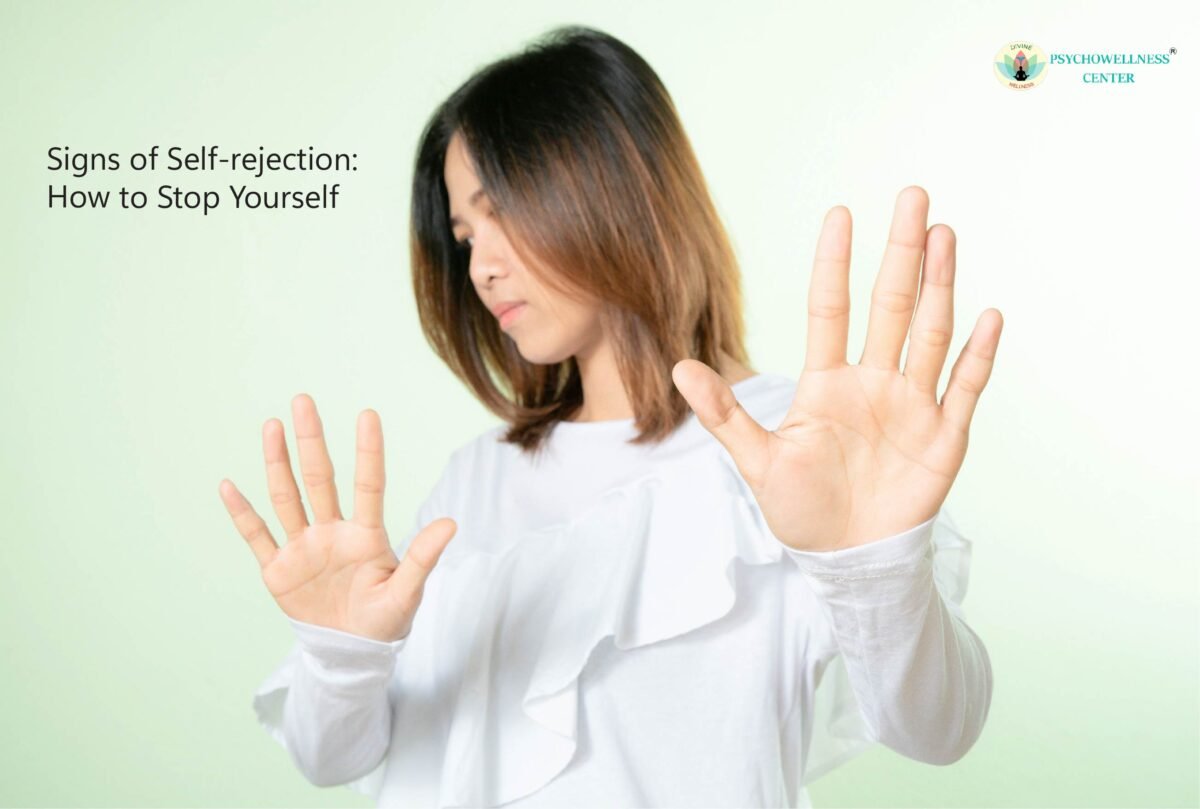
We are often told that our greatest enemy is “out there”: a hyper-critical boss, a judgmental society, or a difficult upbringing. But for many, the most persistent adversary is the one looking back in the bathroom mirror.
Psychologically speaking, self-rejection is the act of dismissing your own value, emotions, or potential before anyone else has the chance to do so. It is a preemptive strike against the pain of external rejection; if you reject yourself first, you feel you have gained a sense of control over the inevitable. However, this “shield” is actually a cage and over time, it can contribute to Stress, Anxiety, depression, and even Burnout.
Part I: The Hidden Signs of Self-Rejection
Self-rejection rarely presents itself in a dramatic “I hate myself” speech. Instead, it lives in the quiet habits and the “logical” excuses we make to stay small. Recognising these signs is the first step in learning how to stop yourself from self-sabotage.
1. The “Preemptive Quit”
Do you ever find yourself withdrawing from a job application, a dating prospect, or a social circle because you’re “certain” they won’t like you? This is a hallmark sign, seen in Social Anxiety and Generalised Anxiety Disorder. By quitting before you can be rejected, you protect your ego from the sting of an external “no,” but you also ensure a 100% failure rate.
2. Chronic People-Pleasing and Boundary Erosion
When you prioritise everyone else’s needs over your own, you are implicitly telling yourself: My needs are not valid. People-pleasing is often a mask for the fear that your authentic self is fundamentally “too much” or “not enough.” If you feel guilty for saying “no,” you are rejecting your right to personal space and time.
3. Discounting the Positive
When someone compliments you, do you immediately point out a flaw or credit “luck”? Minimising achievements is a classic cognitive distortion, often addressed in CBT (Cognitive Behavioural Therapy). This pattern reinforces low self-esteem and maintains a negative self-image, even in high-functioning professionals. By refusing to internalise success, you maintain a self-image of inadequacy. It feels safer to stay in a “low” state than to accept greatness and fear falling from it later.
4. The Harsh Inner Prosecutor
We all have an internal monologue, but for those experiencing self-rejection, that voice is a prosecutor rather than a coach. It focuses on mistakes, ignores progress, and uses “all-or-nothing” language (e.g., “I always mess up,” “I am a total failure”). This voice often mimics the critical figures from our past.
5. Perfectionism as a Defense Mechanism
Many believe perfectionism is about high standards. In reality, it is often a sign of self-rejection. You reject any version of yourself that is flawed, believing that only “perfect” is worthy of love. Since perfection is impossible, you remain in a perpetual state of rejecting your actual, human self.
Part II: The Psychology: Why Do We Reject Ourselves?
To understand how to stop yourself from this cycle, we must look at the biological and developmental “why.”
1. The Biology of Shame
Shame is a biological alarm system. When it becomes chronic, it dysregulates emotional systems linked to serotonin and dopamine, increasing vulnerability to mood disorders such as Persistent Depressive Disorder and Bipolar Disorder.
2. Attachment Theory and the “Internal Working Model”
If our primary caregivers were inconsistent or overly critical, we developed an “Internal Working Model” that says relationships are conditional. As children, we cannot survive the idea that our parents are flawed, so we decide we are the ones who are bad. This childhood survival strategy becomes an adult personality trait.
3. Cognitive Distortions: The Mind’s Eye
Our brains use “heuristics” or mental shortcuts.5 Common distortions include:
- Catastrophizing: Assuming the worst-case scenario.
- Mind Reading: Assuming others are thinking negatively of you without evidence.
- Labeling: Assigning a global negative label to yourself based on one event (e.g., “I failed the test, therefore I am a loser”).
Part III: How to Stop Yourself: A Path to Self-Acceptance
Stopping the cycle of self-rejection is about shifting your relationship with yourself from a judgmental one to a collaborative one. Here are evidence-based strategies to break the loop.
1. Practice “Radical Awareness” and Labelling
You cannot change what you do not notice. For the next week, keep a “Rejection Log.” Every time you talk yourself out of an opportunity or criticize your reflection, write it down.
- The Shift: Move the thought from an objective truth to a subjective event. It’s not “I am ugly”; it’s “I am having a thought that I am ugly.” This creates “cognitive defusion,” a core principle of Acceptance and Commitment Therapy (ACT).
2. The “Best Friend” Filter
We are often far more cruel to ourselves than we would ever be to a friend. When you catch yourself in a spiral, ask: Would I say this to someone I love? If the answer is no, why is it acceptable to say it to yourself? Treating yourself with the same dignity you offer a stranger is a radical act of self-acceptance.
3. Micro-Acts of Courageous Exposure
Self-rejection thrives on avoidance. To break it, you must engage in “exposure therapy” for your ego.
- Apply anyway: Submit that application even if you feel 60% qualified.
- Speak up: Share one opinion in a meeting, even if your heart is racing.
- Accept the compliment: Simply say “Thank you” and let the discomfort of being liked sit there without trying to “fix” it.
4. Re-parenting the Inner Child
When you feel the urge to reject yourself, visualise yourself as a five-year-old child. Would you tell that child they are worthless because they spilt milk? Likely not. Offer that younger version of you the compassion you lacked. This helps separate your “adult observing self” from your “wounded emotional self.”
5. Moving from Self-Esteem to Self-Compassion
Dr. Kristin Neff’s research shows that Self-Esteem is fragile because it depends on being “above average.”6 Self-Compassion is stable because it applies even when you fail.
- Self-Kindness: Being warm toward yourself.
- Common Humanity: Realizing everyone feels like a “fraud” or a “failure” sometimes.
- Mindfulness: Observing pain without letting it define you.
Part IV: Overcoming the Fear of Success and Visibility
Often, we reject ourselves because we are afraid of what happens if we succeed. Success brings visibility, and visibility brings the risk of being judged by a larger audience.
Breaking the “Upper Limit Problem”
Gay Hendricks calls this the “Upper Limit Problem.” We have an internal thermostat for how much success and love we feel we deserve. When we exceed it, we subconsciously reject ourselves or sabotage our progress to get back to our “comfortable” level of unhappiness.
To stop this, you must consciously expand your capacity to hold “good” feelings. When something goes right, resist the urge to find a problem. Sit with the joy for five extra minutes.
Part V: The Long-Term Benefits of Self-Acceptance
When self-rejection softens:
- Boundaries strengthen, reducing Emotional Abuse and unhealthy dynamics
- Emotional resilience improves, buffering against Anxiety, Grief, and loneliness
- Authenticity increases, supporting healthier relationships and workplace confidence
Conclusion
Overcoming the signs of self-rejection is not a linear process. There will be days when the inner critic returns with a megaphone. However, every time you choose to stay present with yourself, even when you’ve messed up, you are building a new neural pathway.
You are not a project to be “fixed” or a problem to be solved. You are a person to be known. The next time you feel the urge to turn your back on yourself, try standing still. You might find that the person you’ve been running from is exactly who you’ve been looking for all along.
If self-rejection feels deeply ingrained or begins to interfere with your relationships, work, or emotional well-being, professional support can be an important step toward healing. Psychowellness Center, with clinics in Dwarka Sector-17 and Janakpuri, offers compassionate, evidence-based care to help individuals work through self-criticism, low self-esteem, anxiety, and burnout. Therapies such as Cognitive Behavioral Therapy (CBT), Acceptance and Commitment Therapy (ACT), self-compassion–focused therapy, and trauma counselling support clients in building healthier self-beliefs and emotional resilience. Appointments can be booked at 011-47039812 / 7827208707. For those who prefer flexible access, TalktoAngel provides confidential online therapy with qualified mental health professionals, making it easier to seek help from anywhere. With the right guidance, the cycle of self-rejection can be replaced by self-acceptance, clarity, and a more authentic connection with yourself.
Contribution: Dr. R.K. Suri, Clinical Psychologist, and Ms. Arushi Srivastava, Counselling Psychologist
References
- Neff, K. D. (2011). Self-Compassion: The Proven Power of Being Kind to Yourself. William Morrow Paperbacks.7 (Focuses on the clinical benefits of kindness over criticism).
- Rogers, C. R. (1961). On Becoming a Person. Houghton Mifflin.8 (The foundational text on “unconditional positive regard”).
- Brown, B. (2012). Daring Greatly. Gotham.9 (Explores how vulnerability is the antidote to shame and self-rejection).
- Hendricks, G. (2009). The Big Leap. HarperOne.10 (Insights on the “Upper Limit Problem” and self-sabotage).
- Harris, R. (2008). The Happiness Trap. Shambhala. (Explains techniques for cognitive defusion from the ACT perspective).
- https://www.psychowellnesscenter.com/Blog/how-to-handle-rejection-in-relationship/
- https://www.psychowellnesscenter.com/Blog/the-root-causes-of-low-self-confidence-childhood-society-and-more/