
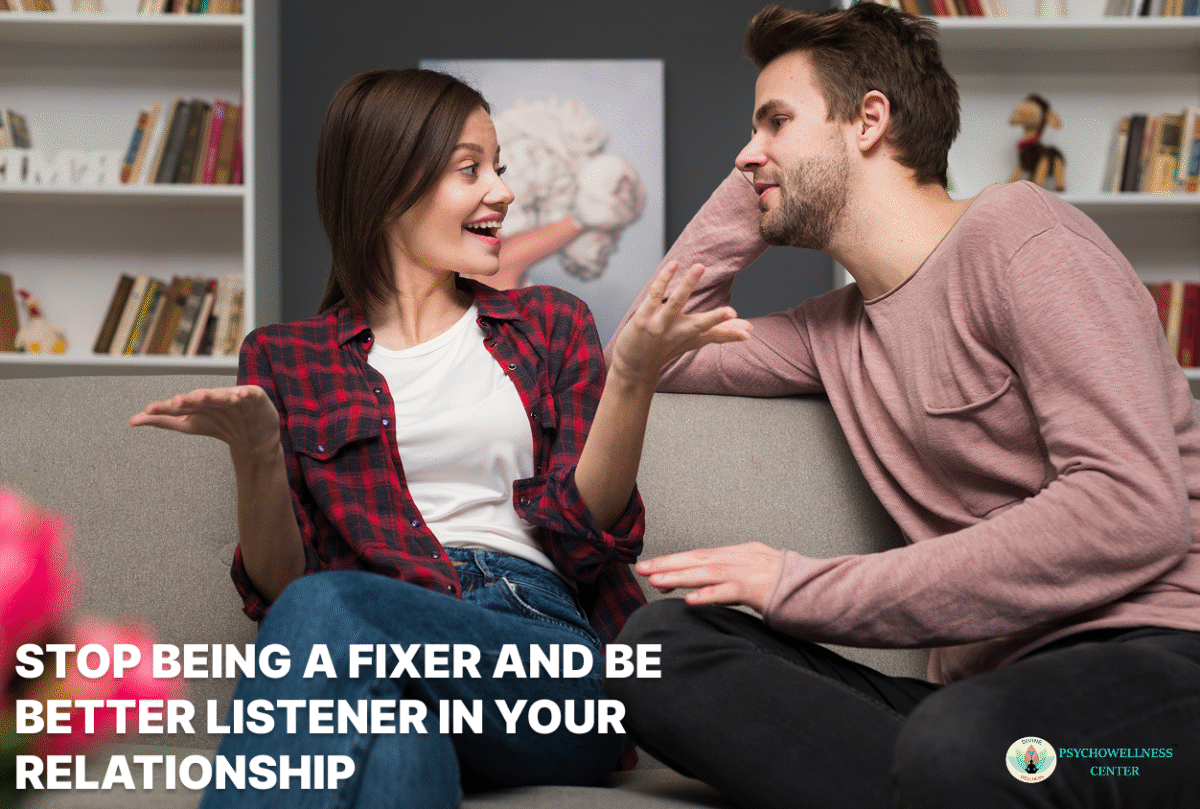
In many relationships, romantic, familial, or even friendships, there is a common dynamic where one partner takes on the role of the “fixer.” This person feels the need to solve every problem, offer advice, or remove discomfort whenever the other is upset. While this often comes from a place of love and care, it can unintentionally damage emotional intimacy and connection. From a psychological and mental health perspective, being a better listener is often more healing and valuable than offering solutions.
Understanding the Fixer Mentality
When someone we care about is in pain, our instinct is often to take away that pain as quickly as possible. This might mean offering practical advice, suggesting solutions, or even trying to “cheer them up.” However, most people don’t want their emotions fixed; they want them acknowledged. This is called emotional validation, the process of recognizing and affirming another person’s feelings without judgment or problem-solving (Linehan, 1993).
Fixers often:
- Jump to conclusions or solutions.
- Struggle to tolerate their partner’s distress.
- Feel responsible for solving every issue.
- Assume that helping equals fixing.
While well-meaning, this approach can leave the other person feeling dismissed, invalidated, or emotionally disconnected. This is especially harmful when a partner is struggling with mental health issues such as depression, anxiety, bipolar disorder, PTSD, OCD, eating disorders, borderline personality disorder (BPD), ADHD, substance use disorder, or social anxiety disorder. Each of these conditions already comes with feelings of vulnerability and misunderstanding; being “fixed” rather than heard often deepens the sense of isolation.
Listening as an Emotional Act
Listening is not just about staying quiet. In psychology, active listening is a communication technique that involves full attention, empathy, and reflection. It is the foundation of effective therapy and emotionally safe relationships.
Core components of active listening include:
- Making eye contact and avoiding distractions.
- Using phrases like “I hear you” or “That sounds really hard.”
- Reflecting feelings back: “You seem really frustrated.”
- Resisting the urge to interrupt or offer advice.
According to Rogers (1951), one of the most therapeutic conditions in any human relationship is unconditional positive regard, offering acceptance and understanding without trying to change the other person. This is what builds trust and emotional closeness.
Why Fixing Can Be Emotionally Harmful
While it might feel helpful in the moment, jumping to fix can harm your relationship in several ways:
- Invalidation: When someone with depression or anxiety shares their emotions and the response is, “Why don’t you just do this?”, it can feel like their feelings are being dismissed.
- Disconnection: A partner living with PTSD or BPD may stop opening up if they sense their pain is being minimized.
- Anxiety escalation: Someone with OCD or social anxiety might feel more pressure when offered “quick fixes” they can’t follow.
Emotional safety, the feeling that you can express your true thoughts and feelings without fear, is essential in healthy relationships. According to Edmondson & Lei (2014), environments with high psychological safety promote openness, learning, and resilience, not just in workplaces but also in personal relationships.
What People Really Want: Emotional Validation
In counseling and therapy, emotional validation is often more healing than practical advice.
For someone with bipolar disorder, this validation can reduce the fear of being judged. For a person with an eating disorder, it creates a sense of being accepted beyond appearance or behavior. For someone struggling with substance abuse disorder, validation shows that they are more than their addiction.
How to Shift from Fixer to Listener
If you’ve been a fixer in your relationships, it’s not too late to shift. Here are practical steps to become a better listener:
- Ask before advising: Try saying, “Do you want to vent, or are you looking for suggestions?” This is especially helpful for partners with ADHD or anxiety who may just need space to express thoughts.
- Reflect emotions, not actions: Say, “You seem really exhausted,” rather than “You should take the day off.” This respects the feelings of those with depression or PTSD.
- Practice patience: Let your partner process emotions before jumping in. People with OCD or BPD may need more time to feel safe sharing.
- Hold space: Sometimes just sitting in silence with someone experiencing grief, anxiety, or trauma is the most powerful support.
- Be okay with not having answers: The goal is not to solve, it’s to connect.
Emotional Presence is Healing
Many people confuse helping with fixing. But emotional presence, being mentally and emotionally available, is what most people actually need.
In fact, therapists are trained not to give advice unless necessary. Instead, they focus on understanding, reflecting, and allowing clients to reach their own conclusions. That’s because people grow emotionally not by being told what to do, but by being supported in how they feel (Neff & Germer, 2013).
For people living with depression, anxiety, OCD, PTSD, ADHD, bipolar disorder, borderline personality disorder, eating disorders, substance use disorder, or social anxiety disorder, this presence can be life-changing. It communicates: “You’re not broken. You’re human, and your emotions matter.”
Conclusion
Healthy relationships aren’t about who gives the best advice or who solves problems the fastest, they’re about who listens with the most presence, empathy, and patience. When you shift from being a “fixer” to a “listener,” you create space for your partner to be fully human, with all their messy, raw, and beautiful emotions.
This not only improves communication but also strengthens emotional safety, builds deeper intimacy, and supports better mental health for both partners. In a world full of quick fixes and noise, becoming a better listener might be the most loving thing you can do.
How Counseling Can Help Shift from Fixer to Listener
Learning to replace fixing with listening is not always easy, especially if it has been your default response in relationships for years. Counseling can provide guidance in building healthier communication patterns. At the Psychowellness Center in Dwarka Sector-17 and Janakpuri (011-47039812 / 7827208707), therapists use approaches like Cognitive-Behavioral Therapy (CBT) to help individuals recognize the thought patterns that drive over-fixing, and Couples Therapy to teach partners skills such as active listening, emotional validation, and boundary-setting. Online therapy platforms like TalktoAngel also offer accessible spaces for individuals or couples to practice these skills with professional support. By working with the best relationship counselor near me, you can learn to create emotionally safe spaces where listening replaces fixing, leading to stronger, more compassionate relationships.
Contributions from Dr. R.K. Suri Clinical Psychologist and Ms. Sakshi Dhankhar Counselling Psychologist strengthen the mental health perspectives in this article.
References
- Edmondson, A. C., & Lei, Z. (2014). Psychological safety: The history, renaissance, and future of an interpersonal construct. Annual Review of Organizational Psychology and Organizational Behavior, 1(1), 23–43. https://doi.org/10.1146/annurev-orgpsych-031413-091305
- Linehan, M. M. (1993). Cognitive-behavioral treatment of borderline personality disorder. New York: Guilford Press.
- Neff, K. D., & Germer, C. K. (2013). A pilot study and randomized controlled trial of the mindful self‐compassion program. Journal of Clinical Psychology, 69(1), 28-44. https://doi.org/10.1002/jclp.21923
- Reis, H. T., & Shaver, P. (1988). Intimacy as an interpersonal process. In S. Duck (Ed.), Handbook of personal relationships (pp. 367–389). John Wiley & Sons.
- Rogers, C. R. (1951). Client-centered therapy: Its current practice, implications, and theory. Boston: Houghton Mifflin.