
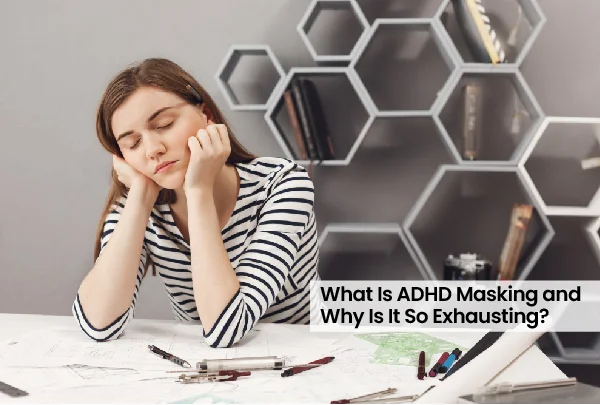
You nod at the right moments, laugh on cue, and plan every sentence before a meeting. From the outside, you look calm and capable. Inside, you are running on empty. This quiet performance is called masking, and it is far more common than most people realise. If you have ever collapsed on the sofa after a “normal” day and wondered why everyone else seems fine, this guide is for you. Here is what masking is, why it drains you, and what actually helps.
What Is ADHD Masking?
Masking (also called camouflaging) means hiding, suppressing, or compensating for ADHD traits so you appear “typical” at work, at school, or in social settings. It can be deliberate or completely automatic.
ADHD masking in adults often goes unnoticed because it looks like politeness, discipline, or hard work. Common examples include:
- Pretending to pay attention while your mind is elsewhere
- Forcing yourself to sit still instead of fidgeting
- Rehearsing conversations before you have them
- Over-preparing for meetings “just in case”
- Copying other people’s reactions or body language
- Avoiding situations where your traits might show
It is also widespread. In a 2026 survey of 202 adults with ADHD in Canada, more than 91% said they camouflaged their traits to some extent. A Dutch study likewise found that adults with ADHD camouflage more than adults without it, though less than autistic adults.
Why Do People With ADHD Mask?
Most people learn it early. Children with ADHD are often corrected for interrupting, fidgeting, or forgetting, and research documents the stigma attached to the condition. Hiding traits becomes a way to stay safe.
Researchers describe this as a trade-off between safety and authentic expression. Typical motives include:
- Fear of judgment, rejection, or discrimination
- Wanting to seem capable and likeable
- Years of criticism from teachers, family, or managers
- Workplace norms that reward looking “on top of everything”
Why Is ADHD Masking So Exhausting?
Does masking use up the brain resources ADHD already strains?
Yes. Masking relies on attention, working memory, and constant self-monitoring, which are the very skills ADHD makes harder. Participants in the 2026 study reported that the extra effort could worsen core symptoms such as poor focus and forgetfulness.
That is where emotional exhaustion and ADHD meet. You never get to switch off, so real recovery never happens. Some participants needed days to bounce back after intense masking.
How does masking affect anxiety and self-esteem?
When you are always watching yourself, worry follows. Many people describe a background fear of slipping up or being “found out”, a pattern that feeds ADHD-related anxiety. Self-worth takes a hit too. Praise lands on the mask, not on you, so self-esteem can become tangled with the belief that the real you is unacceptable. Participants also reported impostor feelings and uncertainty about their identity.
Another study found that masking was most common at school, at work, and at family gatherings, and that it was linked to quality of life. Taken together, the evidence shows why ADHD and mental health cannot be separated from the daily effort of fitting in.
What Are the Signs You Might Be Masking?
- You feel drained after social events, even enjoyable ones.
- You need a long “crash” period afterwards.
- You script conversations in your head before speaking.
- Others call you organised, yet your private life feels chaotic.
- You are unsure what your “real” personality looks like.
- Your symptoms feel louder when you are tired or stressed.
If three or more sound familiar, it is worth paying attention.
How Can You Start Unmasking Safely?
Unmasking is gradual, and researchers note it can take significant time and effort. Start small:
- Track your patterns. For one week, note where and with whom you mask.
- Pick one safe person. Practise dropping the performance with someone who will not judge you.
- Swap suppression for support. Use fidget tools, written agendas, or body doubling instead of forcing stillness.
- Protect recovery time. Schedule quiet time after high-masking events.
- Question the inner critic. Ask whether a trait is truly a flaw or simply a difference.
The burden should not sit on you alone. Workplaces and schools that accept different ways of working reduce the need to hide in the first place.
When Should You Seek Professional Help?
Reach out when exhaustion, low mood, or worry lasts more than a few weeks. Masking can also hide symptoms and delay diagnosis, especially if you have been “coping well” for years.
What does an ADHD evaluation involve?
A Professional psychological assessment for ADHD usually includes a clinical interview, developmental history, standardised rating scales, and checks for conditions that look similar. Clinicians work from the criteria in the DSM-5-TR.
What can therapy offer?
Structured ADHD counselling services in Delhi can teach practical skills for planning, emotional regulation, and self-acceptance and give you a space where you do not have to perform. When you search for a therapist near me in Delhi, look for someone who has worked with neurodivergent clients, and ask about their experience before booking.
What if your child is masking?
Children mask too. A child who is “perfect” at school but falls apart at home may be spending all their energy holding it together. Searching for child counseling near me can help you find a child psychologist who can assess and support them early.
Conclusion
Masking is not a character flaw. It is a learned survival strategy, and it is tiring because it asks your brain to do double duty all day. Understanding it is the first step towards a life that feels lighter and more like your own.
You do not have to work this out alone. TalktoAngel is an online counselling platform where you can speak with a qualified therapist from home, at times that suit you. Psychowellness Center offers professional counselling and psychological support. Book a session with either today, and start taking the mask off at your own pace.
Contributed by: Dr. R.K. Suri, Clinical Psychologist, and Ms. Mahima Mathur, Counselling Psychologist
Frequently Asked Questions
Is masking the same as being fake?
No. Masking is a protective response to real social pressure, not dishonesty. Researchers stress that adults with ADHD are reacting to genuine stigma rather than misreading the world. Unmasking is about feeling safe enough to be yourself, not about dropping kindness or consideration.
Does masking look the same for everyone?
Not quite. How much you mask depends on your environment, upbringing, and how safe you feel around others. Some people mask mostly at work; others mainly with family. The cost also varies, so your experience may differ from someone else’s.
Can masking delay a diagnosis?
Yes. When symptoms are carefully hidden, teachers, doctors, and even family may not notice them. That can mean years of being told you are simply disorganised or not trying hard enough. Mentioning your masking during an evaluation helps the clinician see the full picture.
How long does it take to unmask?
There is no fixed timeline. Masking is often built in childhood, so unlearning it tends to be gradual. Most people begin by dropping the mask in one safe setting, then widen it step by step, ideally with a therapist’s guidance.
References
- When Should Someone Seek Help for Attention and Behavioural Difficulties?
- American Psychiatric Association. (2022). Diagnostic and statistical manual of mental disorders (5th ed., text rev.). https://doi.org/10.1176/appi.books.9780890425787
- Mueller, A. K., Fuermaier, A. B. M., Koerts, J., & Tucha, L. (2012). Stigma in attention deficit hyperactivity disorder. ADHD Attention Deficit and Hyperactivity Disorders, 4(3), 101–114. https://doi.org/10.1007/s12402-012-0085-3
- Mylett, M. L., Boucher, T., & Iarocci, G. (2026). “I wish I could just be myself”: Experiences of social camouflaging in adults with ADHD. Research in Neurodiversity, Article 100018. https://doi.org/10.1016/j.rin.2026.100018
- van der Putten, W. J., Mol, A. J. J., Groenman, A. P., Radhoe, T. A., Torenvliet, C., Agelink van Rentergem, J. A., & Geurts, H. M. (2024). Is camouflaging unique for autism? A comparison of camouflaging between adults with autism and ADHD. Autism Research, 17(4), 812–823. https://doi.org/10.1002/aur.3099
- https://www.psychowellnesscenter.com/Blog/attention-deficit-hyperactivity-disorder/
- https://www.psychowellnesscenter.com/Blog/effective-ways-to-express-your-feelings/
- https://www.psychowellnesscenter.com/Blog/adhd-beyond-attention-emotional-dysregulation-as-the-hidden-struggle/
- https://www.psychowellnesscenter.com/Blog/adhd-counselling-near-me-for-children-and-adults/