
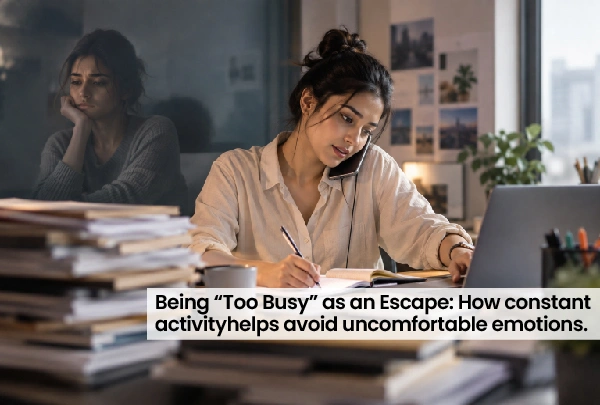
Have you ever noticed that certain people never seem to stop moving? Back-to-back meetings, endless to-do lists, a calendar with no white space. For many, this isn’t ambition, it’s avoidance. Staying constantly busy can be a subtle way of outrunning emotions we’d rather not feel. The irony is that the busier we get to avoid discomfort, the more that discomfort quietly builds underneath. This blog unpacks why “busy” often means “avoiding,” and what to do when constant activity becomes a coping mechanism rather than a choice.
Why Do We Use Busyness to Avoid Emotions?
Staying busy gives the brain something to focus on other than uncomfortable feelings. If you’re constantly doing, there’s no time to sit with grief, fear, or uncertainty.
This is a classic avoidance pattern. It works in the short term busyness genuinely distracts us but it doesn’t resolve what we’re avoiding. It simply delays it, often making emotions bigger and harder to process later.
What Are the Signs That Busyness Has Become an Escape?
Not all busyness is avoidance. The difference lies in why you’re busy and how you feel when things slow down.
Common signs include:
- Feeling anxious or restless during downtime
- Filling every gap in your schedule, even small ones
- Difficulty relaxing without guilt
- Avoiding quiet moments like driving alone or lying in bed
- Using work as a reason to skip emotional conversations
Can Constant Busyness Lead to Work-Related Emotional Exhaustion?
Yes, and this is among the most typical outcomes. When busyness becomes a permanent coping strategy, it often results in Work-Related Emotional Exhaustion, a state where you feel depleted, detached, and unable to recover even after rest.
This exhaustion doesn’t just affect productivity. It seeps into relationships, self-esteem, and long-term motivation, making it harder to function even outside of work hours.
How Emotional Exhaustion Shows Up
- Feeling tired even after a full night’s sleep
- Losing interest in things you used to enjoy
- Increased irritability or emotional numbness
- Struggling to concentrate on simple tasks
How Does Avoidance Through Busyness Affect the Body?
Emotions we don’t process don’t disappear they often show up physically. Chronic stress from nonstop activity can affect Overall Bodily Well-Being, contributing to headaches, muscle tension, digestive issues, and disrupted sleep.
Over time, the body essentially “holds” what the mind refuses to sit with. This is why people who stay busy to avoid emotions often experience unexplained physical symptoms alongside emotional fatigue.
Is There a Link Between Busyness and Anxiety?
Absolutely. For many people, staying busy is a direct response to Persistent Worry And Fear. Constant activity can feel like control if you’re always doing something, there’s less space for anxious “what if” thoughts to take over.
But this relationship works both ways. The busier you get to manage anxiety, the more your nervous system stays in a heightened, alert state, which can actually increase anxiety over time.
How Can Present-Moment Awareness Help Break This Cycle?
Slowing down doesn’t come naturally to those used to constant motion but it’s often exactly what’s needed. Practicing a Present-Moment Awareness Practice helps interrupt the automatic urge to stay busy by gently bringing attention back to what’s happening right now, including uncomfortable feelings.
Simple ways to build this include:
- Before beginning a new work, take five steady breaths.
- Naming physical sensations when you feel the urge to “do something”
- Sitting in silence for two minutes without a phone or distraction
Can Better Time Management Actually Help?
Interestingly, yes but not in the way most people think. Developing Effective Schedule Planning Skills isn’t about doing more efficiently; it’s about intentionally building in space for rest, reflection, and emotional processing.
A well-structured schedule should include:
- Buffer time between tasks
- Designated periods with no obligations
- Regular check-ins with how you’re feeling, not just what you’re doing
What Therapeutic Approaches Help With Avoidance Through Busyness?
Professional support can be incredibly effective in addressing the root causes of chronic busyness. Two evidence-based approaches are particularly helpful:
Cognitive behavioural therapy helps identify the thought patterns driving avoidance such as the belief that slowing down is unsafe or unproductive and gradually shifts them.
Dialectical behaviour therapy focuses on building tolerance for uncomfortable emotions, teaching skills to sit with distress without needing to escape into constant activity.
When Should You Consider Seeking Professional Support?
If busyness has become your default way of avoiding emotions, and slowing down triggers anxiety or discomfort, it may be time to speak with a professional.
Searching for a therapist near me can feel overwhelming, but starting the search itself is a meaningful step toward change. For those in the capital region, options like psychological counselling in Delhi or a qualified psychologist in Delhi NCR provide accessible, structured support for breaking avoidance patterns.
A trained therapist can help you understand what you’re avoiding, why, and how to build healthier ways of coping without relying on constant activity as a shield.
Conclusion
Staying “too busy” might feel productive, but when it’s used to avoid emotions, it often leads to burnout, anxiety, and physical strain rather than genuine relief. Real healing comes from learning to sit with discomfort, not outrun it.
Individuals who feel constantly occupied, overwhelmed by responsibilities, or unable to slow down because staying busy helps them avoid uncomfortable emotions can seek professional support at Psychowellness Center, with services available at Dwarka and Janakpuri, New Delhi (Contact: 011-47039812 / 7827208707). Experienced professionals can provide personalised counselling and practical guidance for concerns related to emotional avoidance, persistent worry, work-related emotional exhaustion, overall well-being, present-moment awareness, and effective schedule planning. TalktoAngel is an online counseling platform that also provides convenient access to professional mental health support for individuals seeking to understand and manage difficult emotions.
Constant activity can sometimes become a way to avoid sitting with difficult thoughts and emotions. Practising present-moment awareness can help create space to pause, reconnect with emotions, and build Mindful Practices for Greater Focus, Calmness, and Joy, supporting healthier emotional coping.
FAQs
How can I tell if I’m avoiding emotions through busyness?
Pay attention to how you feel during downtime. If stillness triggers anxiety, guilt, or restlessness, it may signal avoidance rather than simple time management.
How do I start slowing down without feeling overwhelmed?
Start small, a few minutes of quiet reflection or mindful breathing daily can gently build tolerance for stillness without triggering overwhelm.
Can constant busyness cause burnout?
Yes. Prolonged avoidance through overactivity is strongly linked to emotional exhaustion and burnout, particularly in work settings.
Can therapy really help if I don’t know what emotions I’m avoiding?
Yes. A trained therapist can help you identify underlying emotions you may not be consciously aware of, which is often the first step toward genuine relief.
Contributed by: Dr. R.K. Suri, Clinical Psychologist, and Ms. Mahima, Counselling Psychologist
References
Chawla, N., & Ostafin, B. (2007). Experiential avoidance as a functional dimensional approach to psychopathology: An empirical review. Journal of Clinical Psychology, 63(9), 871–890. https://doi.org/10.1002/jclp.20400
Hayes, S. C., Luoma, J. B., Bond, F. W., Masuda, A., & Lillis, J. (2006). Acceptance and commitment therapy: Model, processes and outcomes. Behaviour Research and Therapy, 44(1), 1–25. https://doi.org/10.1016/j.brat.2005.06.006
Linehan, M. M. (2015). DBT skills training manual (2nd ed.). Guilford Press.
Maslach, C., & Leiter, M. P. (2016). Understanding the burnout experience: Recent research and its implications for psychiatry. World Psychiatry, 15(2), 103–111. https://doi.org/10.1002/wps.20311
https://www.psychowellnesscenter.com/Blog/creating-a-self-care-routine-while-having-busy-schedules/
https://www.psychowellnesscenter.com/Blog/how-to-stop-treating-yourself-like-a-machine/
https://www.psychowellnesscenter.com/Blog/anxiety-counselling-in-delhi-for-high-pressure-careers/
https://www.psychowellnesscenter.com/Blog/how-to-spend-your-day-mindfully/