
Is your child suddenly refusing school, throwing intense tantrums, or withdrawing from friends and family? As a parent, it’s natural to feel worried, confused, and unsure of what’s normal versus what needs professional attention. The good news is that expert help is closer than you think. This guide walks parents in Punjabi Bagh through when to seek support, what a child psychologist actually does, and how to find the right expert for your family — without the guesswork.
Why Might Your Child Need Professional Support?
Children don’t always have the words to explain what they’re feeling, so distress often shows up as behaviour instead. A tantrum, a sudden drop in grades, or a refusal to leave the house can all be signals worth paying attention to.
What Are the Common Signs a Child Needs Help?
Watch for these patterns, especially if they persist for more than a few weeks:
- Frequent meltdowns or aggressive outbursts
- Sudden withdrawal from friends or family
- Declining school performance
- Trouble sleeping or changes in appetite
- Regression, such as bedwetting after being toilet-trained
- Persistent sadness, worry, or irritability
- A reduced drive to act — noticeable disinterest in play, hobbies, or activities they once enjoyed
If several of these show up together, it’s a reasonable moment to consult a professional rather than wait it out.
How Does a Child Psychologist Actually Help?
A child psychologist doesn’t just “talk” to kids — they use structured, age-appropriate techniques to understand what’s really going on beneath the behaviour.
What Approaches Do Child Psychologists Use?
Common evidence-based methods include:
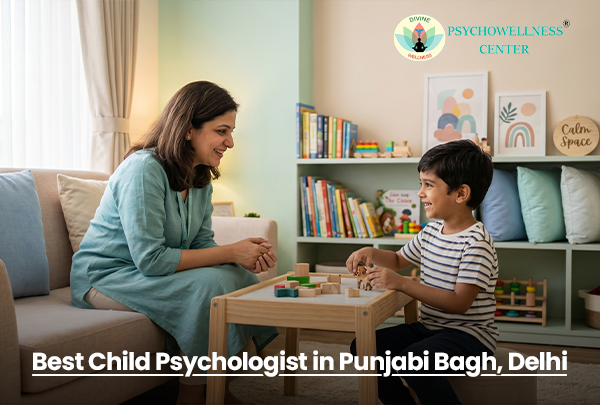
- Play therapy — using toys and games to help young children express emotions they can’t yet verbalise.
- Cognitive Behavioural Therapy (CBT) — teaching children to recognise and reframe unhelpful thoughts.
- Parent coaching — equipping parents with practical strategies to reinforce progress at home.
- Behavioural interventions — for tantrums, aggression, or school refusal.
- Developmental assessments — to identify learning disabilities, ADHD, or autism spectrum traits early.
These approaches aim to strengthen a child’s ability to handle challenges, whether that’s a difficult friendship, a stressful exam, or a major life change like a move or divorce at home.
What Should You Look For in a Child Psychologist Near Punjabi Bagh?
Not every therapist is the best fit for every child. Before booking, check for:
- Relevant qualifications — an M.Phil or Ph.D. in Clinical or Counselling Psychology, ideally RCI-registered
- Experience with your child’s specific concern — anxiety, ADHD, autism, or behavioural issues
- A child-friendly approach — someone who can build trust quickly with young clients
- Parent involvement — sessions or guidance that include you, not just your child
- Convenient access — whether that means an in-clinic option nearby or best Child counselling in Delhi delivered online
If you’re searching “child psychologist near me,” Punjabi Bagh residents have access to well-established clinics as well as reputable online platforms, so distance no longer has to be a barrier to quality care.
10 Experienced Child Psychologists and Counsellors to Know
- Dr. R. K. Suri — A clinical psychologist with over 40 years of experience, specialising in child development, neuropsychological evaluation, and family therapy.
- Mr. Utkarsh Yadav — A counselling psychologist skilled in CBT and parent coaching for children’s anxiety and behavioural challenges.
- Mrs. Kala Sengupta — A clinical psychologist with 35+ years of experience in medical and social psychology, including child and family cases.
- Dr. Kamal Agarwal — A child and occupational therapist with 15+ years of experience in developmental therapy for children with sensory and motor delays.
- Mrs. Sheetal Chauhan — A counselling psychologist with 5+ years of experience guiding children and parents through emotional difficulties.
- Ms. Sakshi Dhankhar — A counselling psychologist with 3+ years of experience, including rehabilitation psychology for children with special needs.
- Ms. Tanu Sangwan — A counselling psychologist supporting children and families with early-stage emotional and behavioural concerns.
- Ms. Swati Yadav — With a Master’s in Counselling Psychology, she supports children and adults with emotional, behavioural, academic, and relationship concerns, specialising in child development, parenting, ADHD, autism, and learning challenges.
- Mrs. Chanchal Agarwal — A counselling psychologist with 6 years of experience supporting children with behavioural and emotional concerns.
- Mr. Harpreet Singh — A counselling psychologist with 4 years of experience working with children and adolescents.
How Does Therapy Support a Child’s Long-Term Development?
Good therapy isn’t only about fixing a specific problem — it lays the groundwork for the years ahead.
Building Skills Beyond the Immediate Issue
A skilled psychologist focuses on nurturing children’s healthy development across emotional, social, and cognitive domains, not just symptom relief. This might include:
- Helping a child identify and name their emotions
- Teaching problem-solving skills for peer conflicts
- Building confidence through small, achievable wins
- Supporting personal growth and development through consistent, age-appropriate encouragement
Supporting Children With Different Needs
Some children think, learn, and process the world differently — and that’s not something to “fix,” but to understand. Psychologists trained in neurodevelopmental differences and needs help identify conditions like ADHD, autism, or sensory processing differences early, so families can access the right support rather than facing years of confusion.
Setting the Right Goals
Therapy works best when it’s specific. A good psychologist collaborates with parents and, where appropriate, the child, on defining meaningful personal targets — such as sitting through a full school day calmly, or making one new friend this term — rather than vague goals like “being happier.”
Conclusion
No parent has to navigate a child’s emotional or behavioural struggles alone. Reaching out early, whether the concern is big or small, gives your child the best chance at thriving both now and later in life.
Psychowellness Center, a trusted multidisciplinary mental health clinic in Delhi NCR, and TalktoAngel, an online platform for counselling, both offer experienced child psychologists who can support your family from Punjabi Bagh and beyond, whether you prefer in-clinic visits or sessions from home.
Contributed by: Dr. R.K. Suri, Clinical Psychologist, and Ms. Mahima, Counselling Psychologist
Frequently Asked Questions
- When is the right age for a youngster to begin visiting a psychologist?
Children as young as three can benefit from play-based therapy; approaches simply adjust based on developmental stage.
2. How many sessions are typically needed?
Many concerns show noticeable improvement within 8–12 sessions, though ongoing developmental support may continue longer.
3. Is online child counselling as effective as in-person sessions?
For many concerns — anxiety, mild behavioural issues, parent coaching — online sessions are just as effective and often more convenient for busy families.
References
- American Academy of Child and Adolescent Psychiatry. (2023). Comprehensive psychiatric evaluation. https://www.aacap.org/AACAP/Families_and_Youth/Facts_for_Families/FFF-Guide/Comprehensive-Psychiatric-Evaluation-052.aspx
- American Psychological Association. (2022). Developmental psychology studies changes across the lifespan. https://www.apa.org/topics/developmental-psychology
- American Psychological Association. (2023). What is psychotherapy? https://www.apa.org/topics/psychotherapy