
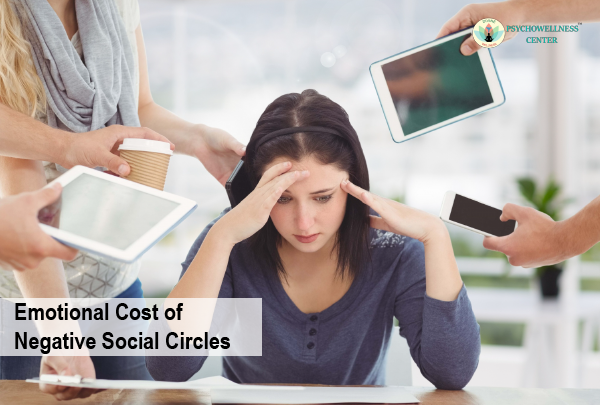
Human beings are inherently social. We thrive on connection, belonging, and shared experiences. However, not all social environments are nurturing. Sometimes, the very circles we rely on for support can become sources of emotional strain. Negative social circles, marked by criticism, competition, manipulation, or lack of empathy, can significantly impact mental well-being, often in subtle yet profound ways.
Understanding Negative Social Circles
A social circle becomes “negative” when interactions consistently drain emotional energy rather than replenish it. This may include toxic friendship dynamics, constant judgment, peer pressure, or lack of genuine support. Research shows that the quality of social relationships matters more than the quantity; unhealthy peer interactions are linked to poorer mental health outcomes and lower life satisfaction .
In such environments, individuals may feel unheard, invalidated, or pressured to conform, leading to internal conflict and emotional distress.
The Silent Rise of Loneliness
Ironically, being surrounded by people does not guarantee emotional connection. One of the most significant emotional consequences of negative social circles is loneliness. This form of loneliness stems not from physical isolation, but from emotional disconnection.
Studies indicate that loneliness arises when there is a mismatch between desired and actual social relationships, and it is strongly linked with depression and poor mental health . When individuals feel misunderstood or excluded within their own social group, the emotional gap widens, making them feel even more isolated.
Anxiety and Emotional Instability
Negative social environments can also heighten anxiety. Constant exposure to criticism, comparison, or unpredictability in relationships can make individuals hyper-aware of their behavior and how they are perceived.
Research highlights that socially anxious individuals tend to focus more on negative interpersonal cues and may avoid real-life interactions due to fear or discomfort. Over time, this creates a cycle where anxiety reinforces withdrawal, further weakening healthy social engagement.
Impact on Self-Worth and Motivation
Being part of a toxic circle can erode self-esteem. When individuals are repeatedly criticized or undervalued, they may begin to internalize these messages. This often results in low motivation, reduced self-confidence, and a diminished sense of purpose.
Negative peer environments can also disrupt personal growth. Instead of encouraging ambition or goal setting, such circles may foster complacency, self-doubt, or even sabotage progress. The absence of encouragement makes it harder to pursue meaningful aspirations.
The Ripple Effect of Social Influence
Social circles influence not only behavior but also emotional states. Research suggests that emotional experiences like loneliness can spread within social networks, affecting not just individuals but entire groups . This “emotional contagion” means that being surrounded by negativity can normalize pessimism, stress, and dissatisfaction.
Additionally, negative peer interactions, such as exclusion or bullying, are associated with increased feelings of loneliness and reduced social functioning. Over time, individuals may adopt maladaptive coping mechanisms, including withdrawal or aggression.
Strain on Relationships
A toxic social environment can distort one’s understanding of a healthy relationship. Individuals may begin to tolerate disrespect, normalize unhealthy communication, or struggle to set boundaries.
This can extend beyond friendships into family and romantic relationships. When negative patterns are internalized, they can affect how individuals communicate, trust, and connect with others, perpetuating a cycle of unhealthy interactions.
Barriers to Self-Improvement
Personal growth requires a supportive and constructive environment. However, negative social circles often hinder self-improvement by discouraging change or growth. Individuals may fear judgment or rejection if they attempt to evolve beyond the group’s norms.
This creates a psychological barrier where staying the same feels safer than pursuing growth. Over time, this stagnation can lead to frustration, dissatisfaction, and a sense of being “stuck” in life.
Breaking Free: Moving Towards Healthier Connections
Recognizing the emotional cost of negative social circles is the first step toward change. While distancing oneself from such environments can be challenging, it is often necessary for mental well-being.
Building healthier connections involves seeking relationships that are supportive, respectful, and growth-oriented. Even a small circle of positive influences can significantly improve emotional health.
For those struggling to navigate these changes, professional support can be beneficial. Consulting the Best Psychologists in Delhi or searching for a therapist near me can provide guidance in understanding patterns, setting boundaries, and rebuilding healthier social networks. Services offering psychological counselling in delhi or access to a qualified psychologist in delhi ncr can help individuals process emotional experiences and develop coping strategies.
Conclusion
The people we surround ourselves with shape our thoughts, emotions, and behaviors more than we often realize. Negative social circles can quietly erode mental health, leading to loneliness, anxiety, low self-worth, and hindered personal growth. Choosing healthier connections is not just a social decision, it is an emotional investment. By prioritizing supportive relationships and seeking help when needed, individuals can create an environment that nurtures well-being, resilience, and growth.
To learn more about coping with the emotional impact of negative social circles and building healthier connections, you can explore professional support at the Psychowellness Center. Services are available in-person at Dwarka and Janakpuri, New Delhi (Contact: 011-47039812 / 7827208707) and online through TalktoAngel, making it convenient to access support from qualified professionals. With the guidance of a trained mental health expert, individuals can develop stronger boundaries, improve relationship choices, and work toward emotional resilience and meaningful personal growth in a safe and supportive environment.
To learn more about coping with the emotional impact of negative social circles and improving overall emotional well-being, you can explore resources that focus on recognising patterns that influence thoughts, emotions, and interpersonal connections. You can also gain insights into how Friendship dynamics shape emotional health and the role of Anxiety in affecting social experiences and self-perception. Additionally, the content highlights the importance of developing Emotion Control and recognising early signs of emotional distress to foster healthier relationships and personal growth.
Contributions: Dr. R.K. Suri, Clinical Psychologist, and Ms. Mahima Mathur, Counselling Psychologist
REFERENCES
Achterbergh, L., Pitman, A., Birken, M., Pearce, E., Sno, H., & Johnson, S. (2020). The experience of loneliness among young people with depression: A qualitative meta-synthesis. BMC Psychiatry, 20(415). https://doi.org/10.1186/s12888-020-02818-3
Baumeister, R. F., & Leary, M. R. (1995). The need to belong: Desire for interpersonal attachments as a fundamental human motivation. Psychological Bulletin, 117(3), 497–529. https://doi.org/10.1037/0033-2909.117.3.497
Christakis, N. A., & Fowler, J. H. (as discussed in recent network research). Social network effects on loneliness. Scientific Reports. https://www.nature.com/articles/s41598-025-99057-x
Lakey, B., & Orehek, E. (2011). Relational regulation theory: A new approach to explain the link between perceived social support and mental health. Psychological Review, 118(3), 482–495. https://doi.org/10.1037/a0023477
https://www.psychowellnesscenter.com/Blog/psychological-risks-associated-with-social-isolation/
https://www.psychowellnesscenter.com/Blog/modern-friendship-and-the-increase-in-loneliness/
https://www.psychowellnesscenter.com/Blog/signs-of-self-rejection-how-to-stop-yourself/
https://www.psychowellnesscenter.com/Blog/how-friends-shape-academic-attitudes-in-teenagers/