
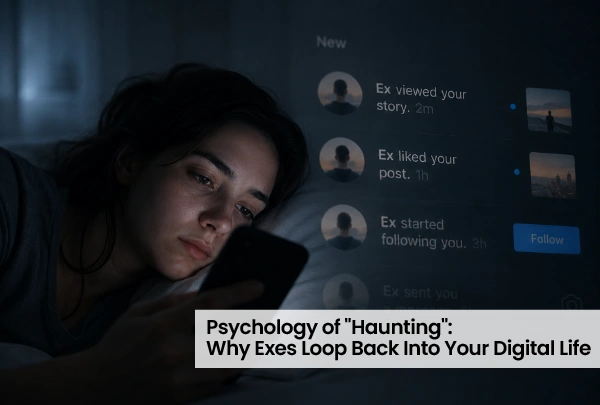
You’ve finally stopped checking your ex’s profile. You’re beginning to move on, and then suddenly, they like an old photo, view your Instagram story, react to a status update, or send a casual “Hey, how have you been?” message. Just when you thought the relationship was in the past, they seem to reappear in your digital world quietly.
This pattern is frequently described by best psychologists in Delhi NCR, counseling in Delhi, and couple counseling near me as “haunting” or “orbiting.” Haunting entails staying online without actively mending the relationship, in contrast to reconnecting with a specific goal. Social media has made it easier than ever for former partners to stay connected from a distance, creating emotional ambiguity that can make healing more difficult. If these experiences leave you feeling confused or emotionally overwhelmed, seeking relationship counselling or consulting a relationship counsellor in Delhi can help you understand the emotional patterns involved and develop healthier coping strategies.
What Is “Haunting” in Relationships?
Haunting occurs when an ex-partner continues interacting with your online presence after the relationship has ended. They may:
- View your stories without contacting you.
- Like old photos or recent posts.
- Occasionally send casual messages.
- React to your updates without starting a meaningful conversation.
Unlike reconciliation, these interactions often lack clear communication or commitment. The mixed signals can leave the other person wondering whether the relationship deserves another chance or whether the contact means anything at all. This uncertainty is one reason digital breakups often feel harder to move past than face-to-face endings.
Why Does This Affect Us So Strongly?
The human brain naturally seeks closure after emotionally significant relationships. When an ex unexpectedly reappears online without explanation, the mind often begins searching for meaning.
Questions such as:
- Do they miss me?
- Are they thinking about getting back together?
- Why are they watching my stories but not talking to me?
Can quickly lead to Overthinking, Anxiety, and emotional confusion. Instead of providing closure, inconsistent digital contact keeps the relationship psychologically active.
The Psychology Behind Digital “Looping Back”
Not all ex-partners come back for the same reason. Sometimes people reach out because they are looking for closure or because they truly miss the relationship. In other cases, the motivation may have little to do with reconciliation.
Psychologists suggest that unresolved attachment needs, loneliness, curiosity, nostalgia, or the desire for reassurance and validation may influence digital reappearances. Because social media allows people to maintain low-effort contact, it becomes easy to remain emotionally present without fully committing to communication. For the person on the receiving end, however, these small interactions can reopen emotional wounds that had slowly begun to heal.
Why Do Exes “Haunt” Your Digital Life?
Not every ex who reappears online wants to rekindle the relationship. In many cases, their behaviour reflects unresolved emotions, curiosity, or attachment patterns rather than a genuine desire to reconnect. Modern dating research suggests that behaviours such as orbiting and breadcrumbing are influenced by factors including attachment insecurity, emotional avoidance, and the ease of maintaining low-effort digital contact.
1. They Haven’t Found Emotional Closure
Ending a relationship doesn’t always mean the emotional bond disappears. Some people continue checking an ex’s social media because they are curious about how the other person is coping or because they have unresolved feelings. Instead of having a direct conversation, they remain connected through occasional likes, story views, or brief messages that require little emotional vulnerability.
2. They Want Validation Without Commitment
Sometimes, digital interactions provide reassurance without the responsibility of rebuilding a relationship. While avoiding more in-depth discussions, a straightforward response to a post or a casual “How are you?” A need for attention or emotional validation may be satisfied by the message. This pattern is often referred to as breadcrumbing, offering just enough contact to maintain a connection without intending to fully re-engage.
3. Attachment Styles Can Influence Their Behaviour
Psychologists have found that attachment styles play an important role in how people behave after a breakup. Individuals with anxious attachment may struggle to let go completely, while those with avoidant attachment may keep minimal digital contact because it feels emotionally safer than direct communication. Research has linked both anxious and avoidant attachment insecurity with breadcrumbing behaviours in modern relationships.
4. Social Media Makes Letting Go More Difficult
Before social media, breakups often involved a natural period of distance. Today, former partners can remain part of each other’s lives simply by following updates online. Every notification, story view, or unexpected “like” can reactivate memories and emotional responses, making it harder to achieve closure. Instead of helping people move forward, these small digital interactions can keep emotional wounds open.
How to End the “Haunting” Cycle
Whether you’re the one being haunted or the one quietly checking an ex’s profile, staying emotionally connected through social media can delay the healing process. Although it may seem harmless, repeatedly monitoring an ex’s online activity often keeps old emotions active instead of allowing them to settle.
- Recognize the Difference Between Curiosity and Attachment
It’s natural to wonder how someone is doing after a breakup. However, if checking their profile affects your mood, leads to overthinking, or makes you question your progress, it may be a sign that the emotional bond hasn’t fully healed.
- Set Healthy Digital Boundaries
Healing sometimes requires creating distance, not only emotionally but digitally as well. Muting stories, unfollowing accounts, or limiting social media exposure isn’t about being immature or resentful; it’s about protecting your emotional well-being while you recover. Healthy boundaries give your mind the space it needs to process the end of the relationship instead of constantly revisiting it.
3. Stop Looking for Hidden Meanings
It’s easy to assume that every like, emoji, or story view has a deeper meaning. In reality, social media interactions are often ambiguous, and trying to decode them can increase confusion rather than provide answers. Instead of asking, “How is this affecting my peace of mind?” is a more useful question than “What are they trying to tell me?”
4. Focus on Your Own Emotional Growth
Rather than waiting for closure from someone else, focus on creating it for yourself. Spending time with supportive people, pursuing personal goals, and reflecting on what you’ve learned from the relationship can gradually reduce emotional dependence on the past. These are also common themes explored in couples counselling, where individuals learn healthier ways to process breakups, strengthen emotional resilience, and build more secure relationships in the future.
When to Ask for Assistance and How to Proceed
Healing after a breakup is rarely linear, especially when digital reminders keep pulling you back into the past. Feeling sad, nostalgic, or curious about an ex is completely normal. But if thinking about the relationship starts to interfere with your ability to sleep, work, feel good about yourself, or make new friends, it can indicate that you’re dealing with unresolved emotional anguish rather than just missing someone.
When Should You Consider Professional Support?
You may benefit from speaking with a mental health professional if you:
- Constantly check your ex’s social media despite wanting to move on.
- Feel trapped in cycles of overthinking or self-blame.
- Experience persistent Anxiety, sadness, or emotional exhaustion after the breakup.
- Compare every new relationship to your previous one.
- Find it difficult to trust others or build new relationships.
Many of these concerns are commonly addressed in relationship counselling, where individuals explore attachment patterns, improve emotional regulation, and develop healthier relationship habits. If recurring thoughts about an ex or confusing online interactions are affecting your emotional well-being, Psychowellness Center offers evidence-based counselling to help you process relationship challenges, build healthy boundaries, and move forward. Visit the Janakpuri or Dwarka clinic or call 7827208707 / 011-47039812 to book an appointment.
Conclusion
In today’s digital world, relationships rarely disappear completely. A story view, an unexpected message, or a reaction to an old post can easily reopen emotions you thought had settled. Understanding the psychology behind haunting reminds us that these interactions often reflect unresolved emotions or attachment patterns rather than clear intentions to reconnect.
Rather than searching for hidden meanings behind every notification, focus on what supports your own emotional well-being. If digital interactions with an ex are affecting your peace of mind, seek professional support. TalktoAngel offers online counselling, while Psychowellness Center provides therapy to help you heal and move forward. Healing doesn’t always mean forgetting the past, it means no longer allowing it to control your present.
Contributions: Dr. R.K. Suri, Clinical Psychologist, and Ms. Ishita Wahi, Counselling Psychologist
References
https://www.psychowellnesscenter.com/service-relationship-issues-counselling-delhi/
https://www.psychowellnesscenter.com/Blog/how-to-stop-overthinking-about-partners-past/
https://www.talktoangel.com/area-of-expertise/healthy-boundary
https://www.talktoangel.com/therapies/acceptance-and-commitment-therapy-act
https://www.talktoangel.com/therapies/cognitive-behavioural-therapy-cbt
Pancani, L., Aureli, N., & Riva, P. (2022). Relationship dissolution strategies: Comparing the psychological consequences of ghosting, orbiting, and rejection. Cyberpsychology: Journal of Psychosocial Research on Cyberspace, 16(2). https://doi.org/10.5817/CP2022-2-9
Travers, M. (2023). What Does It Mean When an Ex-Love Keeps ‘Orbiting’ You Online? Forbes.
Psychology Today. (2021). Breaking Up in the Digital Age.
HealthShots. (2021). Orbiting: Why do exes stay connected on social media?