
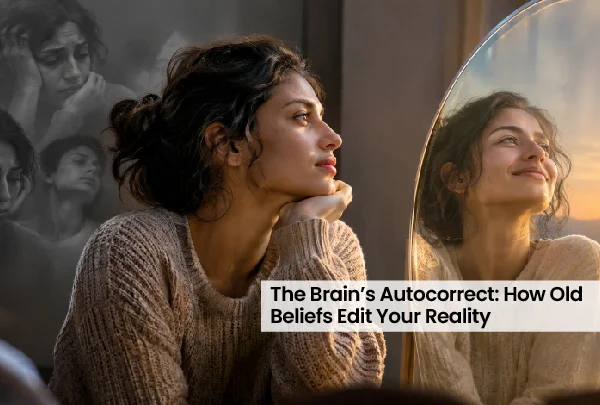
Have you ever received a neutral message and immediately assumed someone was upset with you? Or felt that you were going to fail at something simply because a similar experience went badly in the past? Sometimes, what we experience is not entirely shaped by what is happening around us but by what our mind has learned to expect.
Think of your brain as having an autocorrect feature. Just as your phone automatically changes words based on what it thinks you intended to type, your brain uses previous experiences, memories, and beliefs to interpret new situations. While this mental shortcut helps us understand the world quickly, it can also lead us to misunderstand people, situations, and even ourselves.
This process is closely connected to cognitive schemas, automatic thoughts, and confirmation bias. Understanding how these patterns work can help us recognise when our past is influencing our present and learn to see situations more objectively.
What Does the Brain’s Autocorrect Actually Mean?
The brain’s autocorrect is a simple way of describing how existing beliefs influence our perception, interpretation, and memory of everyday experiences.
Psychologists use the term cognitive schemas to explain mental frameworks developed through childhood experiences, relationships, social interactions, and repeated situations. These schemas help us organise information and make sense of the world.
However, sometimes these mental frameworks become outdated or overly negative.
For example:
- Someone who experienced frequent criticism growing up may interpret constructive feedback as personal rejection.
- A person who has experienced betrayal may find it difficult to trust even genuinely supportive people.
- Someone who faced repeated academic failures may automatically believe they are not intelligent enough to succeed.
According to Beck (2019), underlying beliefs and schemas can influence the automatic thoughts that arise when particular situations trigger them.
In other words, your brain may respond to what it remembers rather than what is actually happening.
How Do Old Beliefs Change the Way We See Reality?
Our previous experiences influence how we notice, interpret, and remember information. Three psychological processes help explain this.
1. Confirmation Bias: Do We Only Notice What We Already Believe?
Confirmation bias refers to the tendency to search for, interpret, and remember information that supports our existing beliefs (Nickerson, 1998).
Imagine someone who believes, “Nobody genuinely likes me.”
When they attend a social gathering, they might:
- Notice the one person who does not greet them.
- Ignore several people who warmly welcome them.
- Interpret a delayed response as deliberate avoidance.
- Remember the uncomfortable interaction more strongly than the positive ones.
Over time, these experiences appear to confirm the original belief, even when the evidence is incomplete.
2. Selective Memory: Why Do Negative Experiences Stay With Us?
Memory is not a perfect recording of everything that happens. It is reconstructive, meaning our existing knowledge and expectations can influence how we remember events.
Schacter (1999) explained that memory can be affected by several distortions, including bias, suggestibility, and misattribution.
For instance, someone who believes they are unsuccessful may remember their mistakes more clearly than their achievements. Their mind gradually builds a personal story that highlights failure while overlooking progress.
3. Automatic Thoughts: Why Do We React Before Thinking?
Automatic thoughts are quick interpretations that appear in response to everyday situations.
For example, receiving a message saying, “We need to talk,” might immediately trigger thoughts such as:
- “I must have done something wrong.”
- “Something terrible has happened.”
- “They are probably angry with me.”
These reactions can create emotional worry even before the actual conversation takes place.
The problem is not having thoughts; it is treating every thought as an established fact.
What Happens When Old Beliefs Start Affecting Mental Well-being?
When negative beliefs repeatedly influence everyday experiences, they can contribute to emotional difficulties and unhealthy behavioural patterns.
Some common effects include:
- Relationship difficulties: Assuming rejection, mistrusting others, or constantly seeking reassurance.
- Low self-esteem: Viewing mistakes as proof of personal inadequacy.
- Emotional distress: Experiencing unnecessary guilt, fear, or self-criticism.
- Avoidance: Staying away from opportunities because of the expectation of failure.
- Overthinking: Repeatedly analysing conversations and imagining negative outcomes.
For example, a person who believes they are not good enough may avoid applying for a promotion. When they miss the opportunity, they might interpret it as further proof that they lack ability.
This creates a cycle in which old beliefs influence present behaviour, and present behaviour reinforces those beliefs.
How Can You Stop Your Brain From Repeating Old Patterns?
The good news is that beliefs are not permanent. With awareness and consistent practice, people can learn to question unhelpful interpretations and develop more balanced thinking patterns.
Here are five practical ways to begin.
1. Identify Your Automatic Thoughts
Pay attention to the first thought that appears when something upsetting happens.
Ask yourself:
- What exactly am I thinking?
- What emotion is this thought creating?
- Does this thought remind me of an earlier experience?
Recognising the thought is the first step towards changing your response.
2. Separate Facts From Assumptions
Before accepting a negative interpretation, identify what you actually know.
For example:
Situation: A friend has not replied to your message.
Presumption: They don’t care about me, which is why they are ignoring me.
Alternative explanations: They may be busy, travelling, working, or simply unable to respond.
This simple exercise helps create space between an event and your interpretation of it.
3. Challenge Old Beliefs With Evidence
When a familiar negative belief appears, ask yourself:
- What evidence supports this belief?
- What evidence contradicts it?
- Am I judging the present through an old experience?
- What would I tell a friend who had the same thought?
Instead of saying, “I always fail,” try replacing it with, “I have experienced setbacks, but I have also succeeded in several situations.”
The goal is not forced positivity but realistic thinking.
4. Practise New Behaviour
Changing beliefs also involves changing the behaviours that keep them alive.
If you believe people will reject you, try initiating a conversation. If you fear making mistakes, take up a manageable challenge.
New experiences can gradually help you develop more flexible expectations.
5. Consider Professional Support
Sometimes, deeply rooted beliefs are connected to childhood experiences, difficult relationships, or distressing life events. In such situations, professional support can help identify and address these patterns.
Cognitive Behavioural Therapy (CBT), for example, helps individuals recognise automatic thoughts, examine underlying beliefs, and develop healthier ways of interpreting situations.
Seeking a psychologist near me can be a useful starting point when these patterns begin affecting relationships, confidence, or daily functioning.
Conclusion
The brain’s autocorrect is not necessarily your enemy. It helps organise experiences and make everyday decisions. However, when old beliefs begin controlling how you interpret every new situation, they can prevent you from recognising opportunities, building healthy relationships, and appreciating your own growth.
The first step towards change is learning to pause, question automatic assumptions, and consider alternative explanations. You do not have to believe every thought your mind produces.
If you need professional guidance, an expert psychologist in India can help you understand underlying beliefs and develop healthier thinking patterns.
Psychowellness Center provides professional psychological counselling and evidence-based therapeutic support for individuals, couples, and families. Its branches are located at Janakpuri Branch: A Block, Janakpuri, and Dwarka Branch: Sector-17, Dwarka. For appointments, contact 09810636188 or 07827208707.
TalktoAngel offers online psychological counselling through convenient digital sessions, making professional support accessible to individuals who prefer seeking help remotely.
Remember, you cannot always control the thoughts that first appear in your mind, but you can learn to question them. Sometimes, changing your reality begins with changing the way you interpret it.
Frequently Asked Questions
1. Can childhood experiences influence how we see things as adults?
Yes. Childhood experiences can contribute to the development of beliefs about ourselves, other people, and the world. These beliefs may influence adult relationships, emotional responses, and decision-making.
2. Is confirmation bias always harmful?
No. It can help the brain process familiar information efficiently. However, it becomes problematic when people consistently ignore contradictory evidence and remain attached to inaccurate beliefs.
3. Can negative thinking patterns be changed?
Yes. With self-awareness, consistent practice, and appropriate psychological support, individuals can learn to recognise automatic thoughts and develop more balanced interpretations.
4. When should someone seek psychological counselling?
Consider professional support when negative beliefs repeatedly affect your relationships, confidence, work, or emotional well-being, or when you find it difficult to change these patterns independently. Searching for counseling near me can help you explore suitable professional support.
Contributed by: Dr. R.K. Suri, Clinical Psychologist, and Ms. Tanu Sangwan, Counselling Psychologist
References
Beck, A. T. (2019). A 60-year evolution of cognitive theory and therapy. Perspectives on Psychological Science, 14(1), 16–20. https://doi.org/10.1177/1745691618804187
Nickerson, R. S. (1998). Confirmation bias: A ubiquitous phenomenon in many guises. Review of General Psychology, 2(2), 175–220. https://doi.org/10.1037/1089-2680.2.2.175
Roese, N. J., & Vohs, K. D. (2012). Hindsight bias. Perspectives on Psychological Science, 7(5), 411–426. https://doi.org/10.1177/1745691612454303
Schacter, D. L. (1999). The seven sins of memory: Insights from psychology and cognitive neuroscience. American Psychologist, 54(3), 182–203. https://doi.org/10.1037/0003-066X.54.3.182
https://www.psychowellnesscenter.com/Blog/automatic-thoughts-causes-and-tips-to-fix-them/
https://www.psychowellnesscenter.com/Blog/letting-go-of-old-versions-of-yourself/