
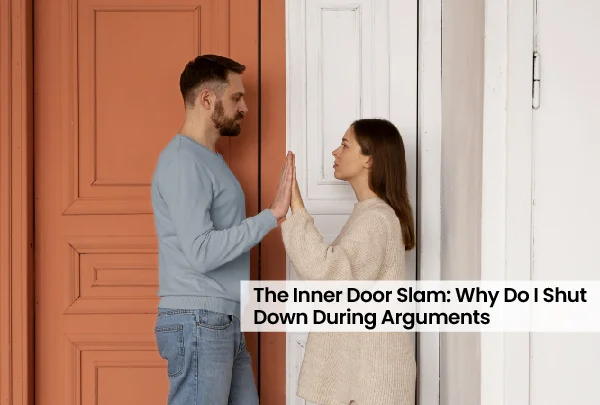
We all have had those moments in the middle of an argument, knowing we have something important to say, but suddenly finding ourselves unable to speak. Your mind goes blank, your emotions feel overwhelming, and all you want to do is withdraw. You might appear distant, silent, or uninterested, even when the conversation matters deeply to you. This experience is often called shutting down during conflict, and it can be more than a communication problem.
Why Do I Shut Down During Arguments?
Shutting down during arguments happens when emotional stress becomes difficult to process, making it harder to think clearly, express feelings, or stay engaged in a conversation. Sometimes, it is a protective response shaped by childhood experiences, emotional overwhelm, or a nervous system. This response is sometimes associated with the freeze response, one of the body’s natural reactions to perceived danger.
So when your brain interprets conflict as threatening, your nervous system may shift into survival mode, instead of finding a solution. Here, you might experience:
- Going completely silent during disagreements.
- Feeling emotionally numb or disconnected.
- Difficulty communicating feelings.
- Becoming defensive but being unable to communicate why.
- Feeling physically exhausted after an argument.
- Wanting to escape the conversation
You should realize that shutting down during conflict doesn’t mean you don’t care. It could also mean that you care so much that your emotional system struggles to manage the intensity of the moment.
Why Does My Mind Go Blank?
So why does your mind go blank during arguments anyway? There are several possible reasons:
- Stress response: Your nervous system becomes highly activated, making it harder to organise your thoughts.
- Fear of saying the wrong thing: You become so concerned about making the situation worse that you struggle to speak.
- Emotional overload: Too many feelings arrive simultaneously, making it difficult to identify what you actually feel.
- Learned avoidance: Previous experiences have taught you that withdrawing is safer than engaging.
- Difficulty identifying emotions: You may recognise that something hurts without knowing how to explain exactly why.
Understanding the reason behind your response is more helpful than criticising yourself for having it.
How Does Childhood Trauma Affect Conflict in Relationships?
If a child is frequently involved in arguments, unpredictable anger, emotional neglect, criticism, or punishment for expressing feelings, then they may have learned that speaking up was unsafe. It later influences how you respond to disagreements as an adult, naming childhood trauma and conflict, and you might develop certain beliefs:
- You learned that silence keeps you safe: If expressing your feelings once resulted in punishment, humiliation, or emotional withdrawal, silence may have become your automatic coping mechanism. And now, you struggle to communicate your needs because you expect a negative reaction.
- Conflict feels like rejection: For someone with a history of childhood trauma, disagreements may trigger a deeper fear of abandonment, disapproval, or losing an important relationship. A simple disagreement can suddenly feel like a threat to emotional security.
- You became hyperaware of other people’s emotions: Growing up with unpredictable emotional reactions makes you spend more time monitoring the other person’s mood than understanding your own feelings.
What is the Connection Between Emotional Overwhelm and Shutting Down?
Emotional overwhelm during conflict happens when an interaction’s intensity exceeds your ability to process and regulate your emotions in the moment. You might start an argument feeling relatively calm, but as the conversation intensifies, your ability to think and communicate starts to fade. This can happen because emotional stress affects the brain’s ability to organise thoughts, process information, and make decisions.
Signs you are emotionally overwhelmed:
- A racing heartbeat or tense muscles.
- Feeling hot, shaky, or restless.
- Difficulty concentrating on what someone is saying.
- Feeling trapped, helpless, or misunderstood.
- A desire to cry but not being able to.
- Going emotionally numb.
- Feeling unable to respond, even when you want to.
Recognising these signs early can help you pause before reaching complete emotional shutdown.
Is Emotional Dysregulation Making It Difficult to Communicate?
Emotional dysregulation refers to difficulty managing the intensity, duration, or expression of emotional experiences during difficult situations. It doesn’t mean you are overly sensitive, immature, or incapable of handling relationships. It means your emotional response may become stronger or more difficult to manage than the situation requires.
During conflict, emotional dysregulation can show up in different ways. Some people become angry or defensive. Others cry, panic, withdraw, or become completely silent. For people who experience shutdown, the emotional response may be less visible.
How Can I Stop Shutting Down During Arguments?
You cannot get comfortable with confrontation overnight. The goal is to develop a greater sense of emotional safety, recognise your triggers, gradually learn how to stay connected to yourself, and avoid conflict in relationships during difficult conversations. You can practise these practical strategies.
- Recognise and understand your triggers, which helps you recognise when your nervous system is becoming overwhelmed.
- Permit yourself to take a break, since a short, intentional pause helps you regain your ability to think and communicate.
- Learn to identify your emotions, as developing emotional awareness can make communication easier.
- Communicate your shutdown response to your partner, as they might misinterpret it as anger, rejection, or a lack of interest.
- Consider seeking professional help with a counselor or trauma-informed therapist that may be helpful depending on your individual experiences.
Healing doesn’t mean you will never feel overwhelmed again. It means learning that you have more choices in how you respond.
Conclusion
Learning why you shut down during arguments begins with understanding your emotional responses and recognising the experiences that may have shaped them. Whether you’re struggling with childhood trauma, emotional overwhelm, conflict avoidance, or difficulty communicating your feelings, developing emotional awareness can help you build healthier relationships and express yourself with greater confidence. However, sometimes professional guidance is needed to understand and work through these patterns.
Searching for a counsellor near me or a therapist near me can be an important step towards better emotional well-being. At Psychowellness Center, offering in-person counselling services in Janakpuri and Dwarka Sector 17, Delhi, experienced mental health professionals provide personalised support to help you understand your emotional triggers, manage overwhelming feelings, improve communication, and develop healthier coping strategies.
Frequently Asked Questions (FAQ)
- Why do I cry or shut down when someone confronts me?
Confrontation can activate intense emotional responses, especially when you associate criticism with rejection or failure.
- How long should I take a break during an argument?
There is no universal time limit. A break of 20–30 minutes may help some people regulate their emotions, while others need longer.
- Is shutting down during conflict the same as stonewalling?
Not necessarily. Shutting down can be an involuntary response to emotional overwhelm, while stonewalling generally describes withdrawing from communication in a way that blocks interaction.
Contributed by: Dr. R.K. Suri, Clinical Psychologist, and Ms. Vandana Krishnan, Counselling Psychologist
References
Dvir, Y., Ford, J. D., Hill, M., & Frazier, J. A. (2014). Childhood maltreatment, emotional dysregulation, and psychiatric comorbidities. Harvard Review of Psychiatry, 22(3), 149–161. https://doi.org/10.1097/HRP.0000000000000014
Gruhn, M. A., & Compas, B. E. (2020). Effects of maltreatment on coping and emotion regulation in childhood and adolescence: A meta-analytic review. Child Abuse & Neglect, 103, 104446. https://doi.org/10.1016/j.chiabu.2020.104446
Villalta, L., Smith, P., Hickin, N., & Stringaris, A. (2018). Emotion regulation difficulties in traumatized youth: A meta-analysis and conceptual review. European Child & Adolescent Psychiatry, 27(4), 527–544. https://doi.org/10.1007/s00787-018-1105-4
https://www.talktoangel.com/blog/impact-of-childhood-neglect-on-adult-depression
https://www.talktoangel.com/blog/effects-of-invisible-childhood-wounds
https://www.talktoangel.com/blog/dealing-with-childhood-trauma
https://www.talktoangel.com/blog/how-to-be-with-an-emotionally-silent-partner
https://www.talktoangel.com/blog/why-do-people-go-quiet-and-stop-reacting