
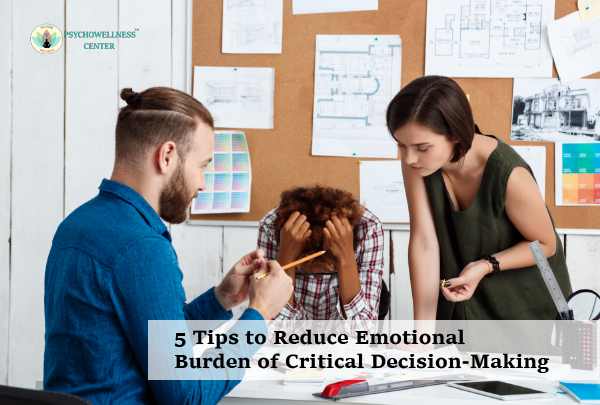
Have you ever spent hours deciding whether to quit a job, move to a new city, end a relationship, or even reply to a difficult text message only to feel emotionally exhausted afterwards? If yes, you are not alone. Critical decisions often carry emotional weight because they involve uncertainty, fear of consequences, and pressure to make the “right” choice.
Decision-making is not just a logical process. It is deeply connected to emotions, past experiences, self-esteem, and even mental health. When emotions become overwhelming, decision fatigue can lead to stress, overthinking, self-doubt, and even physical exhaustion. Some people delay decisions completely, while others impulsively choose just to escape the discomfort.
The good news is that decision-making does not have to feel emotionally draining every time. By learning healthier emotional strategies, you can reduce mental burden and make choices with more clarity and confidence.
1. Stop Treating Every Decision Like a Life-or-Death Situation
One of the biggest reasons people feel emotionally burdened during decision-making is that they magnify the consequences in their minds. Thoughts like:
- “What if I ruin my future?”
- “What if I regret this forever?”
- “What if everyone judges me?”
can quickly create intense anxiety and emotional paralysis.
While some decisions are genuinely important, not every choice needs to carry enormous emotional pressure. Sometimes, our brain creates catastrophic scenarios because uncertainty feels uncomfortable.
Instead of asking:
“What if this goes wrong?”
try asking:
“What if I can handle the outcome even if things don’t go perfectly?”
This shift reduces emotional intensity and reminds you that most decisions are adjustable, flexible, and survivable. Life rarely depends on one perfect choice. Growth often comes from learning through experience rather than controlling every outcome.
2. Separate Emotions from Facts
Emotions are valuable signals, but they are not always accurate predictors of reality. During difficult decisions, people often confuse emotional discomfort with evidence that something is wrong.
For example:
- Feeling nervous about a new opportunity does not always mean it is a bad idea.
- Feeling guilty about setting boundaries does not mean you are selfish.
- Feeling scared about change does not mean you should avoid it.
Many people experiencing chronic overthinking or emotional exhaustion tend to analyse the same situation repeatedly, hoping to gain certainty. Unfortunately, excessive analysis usually creates more confusion instead of clarity. A helpful strategy is to divide your thoughts into two categories: “Facts” and “Feelings”. For instance:
- Fact: “I received a new job offer.”
- Feeling: “I’m afraid I may fail.”
This simple exercise creates emotional distance and allows your mind to process situations more rationally.
3. Permit Yourself to Pause
Modern culture often glorifies quick decisions and constant productivity. However, emotionally healthy decision-making requires space, reflection, and patience. When people feel emotionally overloaded, they may experience:
- racing thoughts
- irritability
- difficulty concentrating
- poor sleep
- physical tension
In such situations, forcing immediate decisions can increase emotional distress. Taking a pause does not mean avoidance. It means regulating your emotional state before making a choice. Some effective ways to emotionally reset include:
- Going for a walk
- Journaling
- Practicing mindfulness
- Talking to someone trustworthy
- Limiting information overload
Even short emotional breaks help the nervous system calm down, making it easier to think clearly. People often make better decisions when they are emotionally regulated rather than emotionally reactive.
4. Stop Seeking the “Perfect” Decision
Perfectionism is one of the hidden reasons decision-making becomes emotionally exhausting. Many individuals believe there is one ideal answer that guarantees happiness, success, or emotional safety. But life rarely works that way. Every decision includes:
- Gains
- Losses
- Uncertainty
- Learning experiences
Trying to eliminate all risks can lead to emotional burnout and chronic indecision. In some cases, this fear becomes linked to low motivation, procrastination, or self-doubt because people become afraid of making mistakes. Instead of asking: “What is the perfect choice?” Try asking: “What choice aligns best with my current values, needs, and goals?” This mindset encourages flexibility instead of perfection.
Remember: A “good enough” decision made with awareness is often healthier than endless emotional struggle over finding a flawless answer.
5. Build Emotional Resilience Instead of Constant Reassurance
Many people feel emotionally burdened because they rely heavily on reassurance from others before making decisions. While support is important, constantly depending on external validation can increase emotional confusion.
For example:
- Asking multiple friends for opinions
- Repeatedly searching online for certainty
- Needing approval before taking action
- Fearing disappointment or rejection
This pattern often increases stress and weakens self-trust over time.
Emotional resilience means learning to tolerate uncertainty while still moving forward. It involves accepting that discomfort is a normal part of growth, change, and decision-making.
One helpful practice to increase emotional resilience is creating a “self-trust journal.” After making decisions, write down:
- What helped you decide
- What strengths did you use
- What you learned afterwards
Over time, this builds confidence in your ability to handle future challenges. Often, confidence develops after action, not before it.
Why Decision-Making Feels So Emotionally Heavy
Critical decisions activate emotional areas of the brain connected to fear, safety, and identity. This is especially true when decisions involve:
- Career changes
- Finances
- Family expectations
- Personal identity
- Future uncertainty
For some individuals, unresolved emotional experiences, fear of failure, or past criticism can intensify the burden. In emotionally overwhelming situations, people may also experience social anxiety, emotional withdrawal, irritability, or difficulty communicating their needs.
That is why emotional awareness matters just as much as logical thinking. Healthy decision-making is not about eliminating emotions, it is about understanding them without becoming controlled by them.
Small Habits That Make Decision-Making Easier
Here are a few practical habits that can reduce emotional overload:
- Limit excessive comparison with others
- Avoid making major decisions while emotionally overwhelmed
- Maintain healthy routines and sleep schedules
- Break large decisions into smaller steps
- Focus on progress rather than perfection
- Practice mindfulness and emotional grounding
- Seek professional support if emotional distress becomes persistent
Sometimes, talking to a mental health professional can help individuals understand the deeper emotional patterns behind indecision, fear, or chronic stress.
Conclusion
Critical decisions are a natural part of life, but they do not have to become emotionally overwhelming. By learning emotional awareness, building self-trust, managing stress, and reducing perfectionism, individuals can approach decision-making with greater clarity and emotional balance.
The Psychowellness Center offers professional mental health support for individuals dealing with emotional overwhelm, relationship difficulties, anxiety, and life challenges through experienced psychologists and counsellors. Individuals searching for a trusted relationship counsellor in Delhi, relationship counselling in Delhi NCR, or effective couple counselling near me can seek expert guidance at Psychowellness Center for emotional and interpersonal concerns.
For additional mental health awareness and self-help resources, individuals can also explore the Psychowellness Center YouTube Channel, which features informative videos on relationship counselling, couple conflicts, emotional balance, stress management, and healthy communication strategies.
For expert assistance, interested individuals can visit the center’s locations in Dwarka and Janakpuri, New Delhi, or contact 011-47039812 or 7827208707 for professional counselling and psychological support.
Contributions: Dr. R.K. Suri, Clinical Psychologist, and Ms. Riya Rathi, Counselling Psychologist
References
- Hayes, S. C., Strosahl, K. D., & Wilson, K. G. (2016). Acceptance and commitment therapy: The process and practice of mindful change (2nd ed.). Guilford Press.
- Greenberg, L. S. (2011). Emotion-focused therapy. American Psychological Association. https://doi.org/10.1037/12323-000
- Norcross, J. C., & Lambert, M. J. (2018). Psychotherapy relationships that work III. Psychotherapy, 55(4), 303–315. https://doi.org/10.1037/pst0000193