
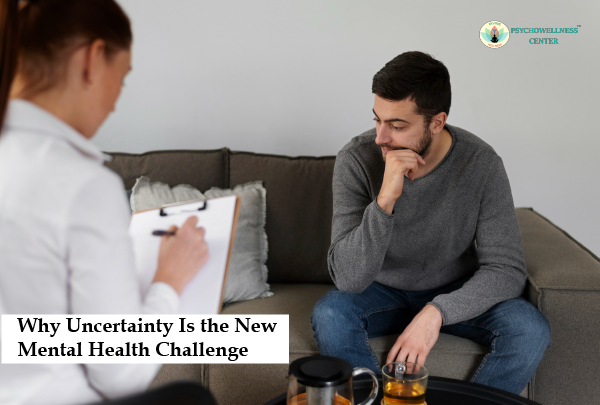
In today’s fast-changing world, uncertainty is no longer an occasional experience—it has become a constant backdrop to our lives. Whether it’s career instability, social changes, or personal transitions, the “unknown” is shaping how we think, feel, and behave. Increasingly, psychologists are recognising uncertainty not just as a situational stressor, but as a central driver of modern mental health struggles.
The Psychology Behind Uncertainty
Uncertainty refers to the inability to predict or control future outcomes. While this may seem like a neutral concept, the human brain is wired to seek predictability. When certainty is absent, the brain interprets it as a potential threat.
Research shows that uncertainty is closely linked to anxiety, as individuals tend to overestimate negative outcomes when the future is unclear. This is why even minor unknowns—like waiting for a message or a job response—can trigger disproportionate worry.
Moreover, uncertainty affects how we learn and make decisions. Studies indicate that people experiencing high uncertainty often avoid risks, even when the outcomes could be beneficial, leading to reduced adaptability and growth.
Why Uncertainty Feels Overwhelming Today
While uncertainty has always been part of life, several modern factors amplify its psychological impact:
- Constant exposure to information (and misinformation)
- Social comparison through digital platforms
- Rapid lifestyle and career changes
- Reduced tolerance for discomfort
These factors contribute to chronic stress, where the mind remains in a prolonged state of alertness. Over time, this can lead to emotional exhaustion, sleep disturbances, and even physical symptoms.
Another subtle effect is low motivation. When outcomes feel unpredictable, people often struggle to initiate or sustain efforts because the reward seems uncertain. This creates a cycle of avoidance and stagnation.
The Emotional Cost of “Not Knowing”
Uncertainty doesn’t just affect thoughts—it deeply impacts emotions. People often experience:
- Fear of making wrong decisions
- Overthinking and “what if” scenarios
- Difficulty with emotion control
- Increased irritability and frustration
Psychological research highlights that uncertainty fuels anticipatory fear—the fear of what might happen—which is often more distressing than actual negative events. Interestingly, the brain reacts more strongly to unpredictable threats than to predictable ones. This explains why ambiguity feels more exhausting than certainty, even if the outcome is unfavourable.
The Hidden Link with Depression and Burnout
While uncertainty is commonly associated with anxiety, it also contributes to depressive patterns. When individuals feel they have little control over outcomes, they may develop a sense of helplessness. This can impact goal setting, as people become hesitant to plan for the future. Over time, this reduces engagement in meaningful activities, leading to emotional numbness and burnout. In professional settings, uncertainty about job roles, expectations, or growth opportunities can significantly affect mental well-being, making employees feel disconnected and disengaged.
Can Uncertainty Ever Be Positive?
Surprisingly, not all uncertainty is harmful. Some level of unpredictability can enhance curiosity, learning, and creativity. It pushes individuals out of rigid thinking patterns and encourages adaptability. In fact, uncertainty can support self-improvement by challenging individuals to develop resilience, flexibility, and problem-solving skills.
Coping Strategies for Managing Uncertainty
Managing uncertainty doesn’t mean eliminating it—it means changing your relationship with it. Here are evidence-based approaches:
- Focus on What You Can Control:- Shift attention from unknown outcomes to actionable steps. This reduces helplessness and increases clarity.
- Practice mindfulness therapy:- Mindfulness helps anchor attention in the present moment, reducing overthinking and worry about the future. Research suggests it can significantly reduce stress responses associated with uncertainty.
- Reframe Thoughts with cognitive behavioural therapy:- CBT techniques help identify irrational fears and replace them with realistic thinking patterns. This is particularly effective in reducing anxiety related to uncertainty.
- Limit Information Overload:- Constantly seeking answers can worsen uncertainty. Setting boundaries around news and social media consumption can help maintain emotional balance.
- Build Tolerance Gradually:- Expose yourself to small, uncertain situations and learn to sit with discomfort. Over time, this increases psychological resilience.
When to Seek Professional Help
If uncertainty begins to interfere with daily functioning—such as sleep, decision-making, or relationships—it may be time to seek support. Working with a therapist near me or accessing psychological counselling in Delhi can provide structured guidance. Professionals trained in anxiety counselling help individuals build coping mechanisms tailored to their needs. Consulting a psychologist in Delhi NCR or reaching out to the best psychologists in Delhi can make a significant difference, especially when uncertainty leads to chronic stress or emotional distress.
Conclusion
Uncertainty is no longer just a passing phase—it is a defining feature of modern life. While it can trigger anxiety, stress, and emotional imbalance, it also holds the potential for growth and transformation. The challenge is not to eliminate uncertainty, but to build the psychological flexibility to live with it. With the right tools—therapy, mindfulness, and adaptive thinking—uncertainty can shift from being a source of fear to a space of possibility.
To better understand and cope with the psychological impact of uncertainty in today’s fast-paced world, you can explore professional support at the Psychowellness Center. Services are available in-person at Dwarka and Janakpuri, New Delhi (Contact: 011-47039812 / 7827208707). With the support of trained specialists, individuals can learn to manage uncertainty, regulate emotional responses, reduce anxiety, and build resilience through evidence-based approaches such as cognitive behavioural therapy and mindfulness techniques, helping them navigate life’s unpredictability with greater confidence and emotional balance.
In a world shaped by uncertainty, learning to set goals can provide direction and stability even when the future feels unclear. When individuals struggle with anxiety, breaking goals into small, manageable steps helps reduce overwhelm and build a sense of control. At the same time, developing emotional control allows people to respond thoughtfully rather than react impulsively, making it easier to adapt to unpredictable situations while maintaining mental balance.
Contributions: Dr. R.K. Suri, Clinical Psychologist, and Mr. Mahima , Counselling Psychologist
References
- Chen, S., Yao, N., & Qian, M. (2018). The influence of uncertainty and intolerance of uncertainty on anxiety. Journal of Behavior Therapy and Experimental Psychiatry, 61, 60–65. https://doi.org/10.1016/j.jbtep.2018.06.005
- Grupe, D. W., & Nitschke, J. B. (2013/2020). Uncertainty and anticipation in anxiety. Nature Reviews Neuroscience / related PMC sources.
- Omary, A. (2023). How uncertainty causes anxiety. Psychology Today. https://www.psychologytoday.com
- Robinson, O. J., et al. (2019). Altered learning under uncertainty in mood and anxiety disorders. Nature Human Behaviour, 3, 1116–1123. https://doi.org/10.1038/s41562-019-0628-0