
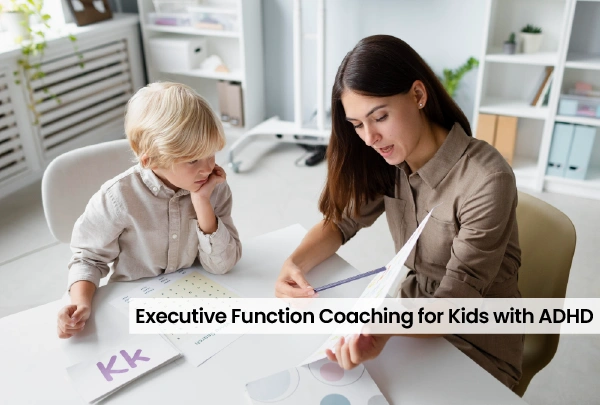
Children do not always struggle because they lack ability or motivation. Sometimes, the challenge lies in managing the mental skills required to plan, organise, remember instructions, shift attention, control impulses, begin tasks, and complete them. These skills are collectively known as executive functions. For children with ADHD, difficulties with executive functioning can affect schoolwork, routines, friendships, and confidence. Executive function coaching focuses on teaching practical skills that help children manage these everyday demands more independently.
The American Academy of Pediatrics recommends behavioural interventions, family involvement, classroom supports, and individualized educational interventions as important components of care for school-aged children with ADHD.
What Is Executive Function Coaching?
Executive function coaching is a structured, skills-based approach that helps children understand how they manage tasks and where they need additional support. Instead of simply telling a child to “pay attention” or “be organised,” coaching breaks complex expectations into smaller, achievable steps.
A coach or mental health professional may help a child learn how to use checklists, calendars, visual schedules, timers, reminders, task breakdowns, and routines. The emphasis is on repeated practice so that strategies gradually become more familiar and useful in everyday situations.
For example, completing homework can be divided into several steps: taking out the required books, identifying the first task, estimating how long it may take, completing a short work period, checking the work, and packing the schoolbag. This reduces the cognitive load associated with managing the entire task at once.
Executive Functions That Children May Need to Strengthen
Executive functioning includes several interconnected skills. Children that have working memory are better able to retain information while using it. Inhibitory control supports pausing before acting. Cognitive flexibility allows children to shift between activities or adapt when plans change. Planning and organisation help them work toward an outcome in a structured manner.
Children may also struggle with time management, task initiation, prioritisation, and monitoring their own performance. These difficulties can sometimes be mistaken for laziness, carelessness, or unwillingness to cooperate.
Research suggests that some non-pharmacological interventions can improve executive functioning in children and adolescents with ADHD. A 2023 systematic review and meta-analysis of 67 studies found beneficial effects from several approaches, including cognitive training, executive-function-specific programmes, mindfulness practice, neurofeedback, and physical exercise, although the effects varied across intervention types and outcomes.
How Coaching Works in Everyday Life
Effective coaching connects executive-function strategies to situations that matter to the child. A younger child may need help getting dressed and ready for school without repeated parental reminders. An older child may need strategies for managing assignments, examinations, extracurricular activities, or multiple deadlines.
One useful approach is goal setting. Rather than establishing a broad goal such as “be more responsible,” the child and adult can identify a specific behaviour, such as “pack the schoolbag independently every evening.” The goal can then be divided into smaller steps and monitored over time.
External supports are especially useful because children should not be expected to rely entirely on internal organisation skills that are still developing. Visual reminders, colour coding, labelled storage, written instructions, and predictable routines can make expectations clearer.
The Role of Parents and Teachers
Executive function coaching works best when adults provide consistent support across settings. Parents and teachers can use similar language, routines, and expectations so that children do not have to learn completely different systems at home and school.
Positive reinforcement can also encourage progress. Recognising effort, persistence, and successful use of a strategy can be more constructive than repeatedly highlighting mistakes. The AAP guideline emphasizes behavioural interventions and parent training, as well as classroom and educational supports, as important elements of ADHD management.
It is also important to remember that children develop at different rates. Expectations should therefore be age-appropriate and adjusted according to the child’s abilities.
When Other Interventions May Be Helpful
Executive-function difficulties can occur alongside emotional, developmental, learning, or behavioural concerns. Some children may also experience anxiety, frustration, low self-confidence, or difficulties in their relationship with parents, teachers, or peers as a result of repeated academic or behavioural struggles.
A comprehensive evaluation can help determine whether additional interventions are appropriate. Occupational therapy for ADHD may be considered when difficulties involve functional skills, sensory processing, motor coordination, routines, or participation in daily activities. Depending on the child’s needs, play therapy or psychological interventions may also provide opportunities to develop emotional awareness, communication, coping skills, and social functioning.
Children with a developmental delay or co-occurring learning difficulties may require additional assessment and individualized educational or therapeutic support rather than executive-function coaching alone.
Does Executive Function Training Work?
Research supports the idea that targeted interventions can improve some aspects of executive functioning, but results need to be interpreted carefully. Not every programme produces broad improvements that automatically transfer to academic performance or everyday behaviour.
For example, an earlier meta-analysis of cognitive training programmes found improvements in trained skills such as short-term memory but limited evidence for broader academic and behavioural benefits. More recent evidence has been encouraging regarding broader non-pharmacological approaches, particularly when interventions specifically target executive skills and are integrated with practical supports.
Therefore, coaching should not be presented as a cure for ADHD. Instead, it can be one component of a broader, individualized support plan.
Finding Appropriate Support for Your Child
Parents seeking Child Counseling Near me or kids therapist near me should consider the professional’s qualifications, experience with childhood concerns, understanding of ADHD, and ability to work collaboratively with families and schools. Child counseling can address emotional and behavioural concerns that may accompany difficulties with executive functioning.
Parents may also benefit from consulting a best Child psychologist in Janakpuri or another qualified child mental health professional who can conduct an appropriate assessment and recommend interventions based on the child’s individual strengths and needs.
Conclusion
Executive function coaching can help children build practical skills for planning, organisation, time management, task initiation, working memory, flexibility, and self-monitoring. The goal is not to change a child’s personality but to provide tools that make everyday demands more manageable.
To better understand attention, planning, organisation, working memory, emotional regulation, task initiation, and everyday behavioural functioning, children experiencing executive functioning difficulties associated with ADHD can seek professional support at Psychowellness Center. Services are available in person at Dwarka and Janakpuri, New Delhi (Contact: 011-47039812 / 7827208707) and online through TalktoAngel, an online platform for counselling. With the guidance of experienced clinical psychologists and mental health professionals, executive function coaching can help children develop practical strategies for managing routines, organising schoolwork, following instructions, regulating emotions, managing time, and completing tasks. Through personalised assessment, parent guidance, behavioural strategies, and appropriate therapeutic interventions, professionals can identify individual strengths and challenges, support academic and social functioning, and create structured approaches suited to each child’s developmental needs, ultimately promoting confidence, independence, emotional well-being, and healthier daily functioning.
Executive function coaching can help children with ADHD strengthen planning, organisation, attention, and emotional regulation skills through practical, age-appropriate strategies. Accessing professional guidance for children with attention and behavioural needs can further support confidence, independence, and success at home and school.
Frequently Asked Questions
- At what age can children benefit from executive function coaching?
Children of different ages can benefit, provided the strategies are adapted to their developmental level. Younger children may need support with routines and transitions, while older children may benefit from help with homework, time management, planning, and academic responsibilities.
- Can executive function coaching replace ADHD treatment?
No. Executive function coaching is not a cure for ADHD and does not necessarily replace other interventions. Depending on the child’s needs, it can complement behavioural strategies, parent training, educational support, psychological interventions, or medical treatment recommended by qualified professionals.
- How can parents support executive functioning at home?
Parents can use visual schedules, checklists, timers, labelled storage, consistent routines, and simple step-by-step instructions. Praising effort and successful use of strategies can also encourage children to develop greater independence.
- When should parents seek professional help for executive functioning difficulties?
Parents should consider professional support when difficulties with attention, organisation, emotional regulation, task completion, or routines consistently interfere with school, home life, friendships, or the child’s confidence. A qualified child psychologist or mental health professional can assess the child’s needs and recommend appropriate support.
Call For Action
The services provided by Psychowellness Center may be of interest to those in need of expert psychological assistance. The clinic offers private, evidence-based mental health care and has convenient locations in Janakpuri and Dwarka Sec-17, Delhi. People can call 011-47039812 or 7827208707 to schedule an appointment or find out more about the services.
Contributions: Dr. R.K. Suri, Clinical Psychologist, and Ms. Mahima, Counselling Psychologist
References
American Academy of Pediatrics, Subcommittee on Attention-Deficit/Hyperactivity Disorder, Steering Committee on Quality Improvement and Management. (2019). Clinical practice guideline for the diagnosis, evaluation, and treatment of attention-deficit/hyperactivity disorder in children and adolescents. Pediatrics, 144(4), e20192528. https://doi.org/10.1542/peds.2019-2528
Rapport, M. D., Orban, S. A., Kofler, M. J., & Friedman, L. M. (2013). Do programs designed to train working memory, other executive functions, and attention benefit children with ADHD? A meta-analytic review of cognitive, academic, and behavioral outcomes. Clinical Psychology Review, 33(8), 1237–1252. https://doi.org/10.1016/j.cpr.2013.08.005
https://www.psychowellnesscenter.com/service-adhd-counselling-delhi/
https://www.psychowellnesscenter.com/Blog/how-behavioral-therapy-helps-adhd-children/