
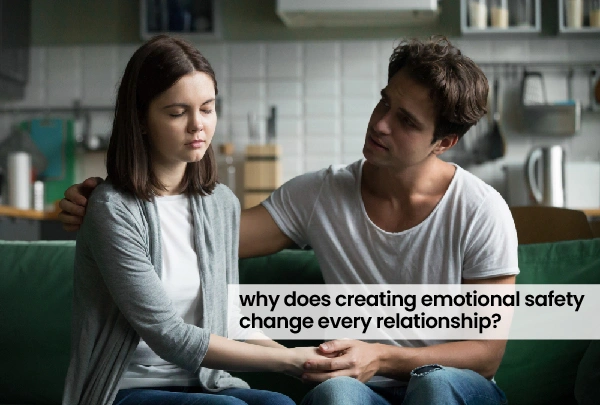
Relationships are not built only through love, shared experiences, or spending time together. They also depend on something less visible but equally important is emotional safety.
Emotional safety means feeling that you can express your thoughts, feelings, fears, and needs without constantly worrying about being judged, mocked, ignored, threatened, or rejected. It does not imply that disputes never occur. Instead, it means that even during disagreements, both people can feel respected and heard.
Whether it is a romantic relationship, marriage, friendship, family relationship, or professional relationship, emotional safety can significantly influence how people communicate and connect with each other.
What Is Emotional Safety?
Emotional safety is the sense that you can be emotionally open with another person while still feeling respected and accepted.
For example, imagine telling your partner, “I felt hurt when you didn’t include me in that decision.” In an emotionally safe relationship, the response might be, “I didn’t realise it affected you that way. Tell me what happened.”
The person may not necessarily agree with everything you say, but they make space for your feelings.
Emotional safety involves:
- Feeling heard and understood
- Being able to express disagreement respectfully
- Knowing that vulnerability will not be used against you
- Feeling accepted even when you make mistakes
- Being able to communicate your needs
- Having disagreements without fear of humiliation or retaliation
- Trusting that personal information will be treated with care
Why Does Emotional Safety Matter So Much?
When people feel emotionally safe, they are more likely to communicate honestly.
When people do not feel safe, they may begin hiding their feelings, avoiding difficult conversations, becoming defensive, or constantly trying to predict the other person’s reaction.
Over time, this can create emotional distance.
Research on relationships has highlighted the importance of perceived partner responsiveness, the feeling that another person understands, validates, and cares about one’s needs, in developing intimacy and closeness (Reis et al., 2004).
In simple words, we become closer to people when we feel that our emotional experiences matter to them.
Emotional Safety Allows Vulnerability
Vulnerability is an important part of meaningful relationships. Sharing fears, insecurities, disappointments, and personal experiences requires trust.
However, vulnerability becomes difficult when someone has previously been criticised, laughed at, dismissed, or punished for expressing themselves.
For instance, if someone says, “I’m feeling insecure about my work,” and repeatedly receives responses such as “You’re too sensitive” or “Stop overthinking,” they may eventually stop sharing.
The person may still be physically present in the relationship but become emotionally closed.
Creating emotional safety makes it easier to say:
“This is bothering me.”
“I need help.”
“I don’t agree.”
“I’m scared.”
“I made a mistake.”
These simple statements can create deeper connection when they are received with empathy.
Emotional Safety Does Not Mean Avoiding Conflict
One common misunderstanding is that emotionally safe relationships are relationships without arguments.
That is not realistic.
Every relationship can have disagreements. Partners may have different opinions, expectations, priorities, and communication styles.
The difference is how conflict is handled.
In an emotionally safe relationship, disagreement does not automatically become personal criticism. Partners can discuss the issue while maintaining respect for each other.
For example:
Instead of:
“You never care about what I say.”
A person might say:
“I felt unheard during our conversation. Can we talk about it again?”
The second approach focuses on the experience and creates an opportunity for conversation rather than immediately attacking the other person.
Emotional Safety Changes Communication
When people feel safe, communication can become more honest and direct.
Without emotional safety, people may use indirect communication, silence, sarcasm, withdrawal, or anger because they are afraid that expressing their actual feelings will lead to conflict.
With emotional safety, people are more likely to say what they actually need.
For example:
“I need some reassurance.”
“I need some time alone.”
“Rather than offering me advice, could you just listen?”
Clear communication reduces the need for guessing and mind-reading.
It Builds Trust Through Consistency
Emotional safety is not created through one big conversation. It develops through repeated experiences.
When someone consistently listens, respects boundaries, keeps promises, acknowledges mistakes, and responds with empathy, trust can gradually strengthen.
Small actions matter.
Remembering something important to your partner, checking in after a difficult day, apologising when you are wrong, or allowing someone to express a different opinion can all contribute to emotional safety.
Trust grows when words and behaviour become reasonably consistent over time.
Emotional Safety Is Important in Every Relationship
Romantic relationships
Emotional safety allows partners to discuss needs, expectations, insecurities, intimacy, anxiety, stress, burnout, trauma, and disagreements more openly.
Friendships
A friendship can become stronger when people feel comfortable sharing personal experiences without worrying that their vulnerability will become gossip or criticism.
Family relationships
Family members may have different beliefs and personalities. Emotional safety can help create space for differences while maintaining respect.
Workplace relationships
Professional environments also benefit from psychological and emotional safety. People are more likely to communicate concerns, ask questions, admit mistakes, and contribute ideas when they do not fear humiliation or unnecessary punishment.
How Can You Create Emotional Safety?
Creating emotional safety begins with everyday behaviour.
- Listen before responding. Sometimes people want understanding rather than immediate solutions.
- Validate feelings. Validation does not mean agreeing with everything. It means acknowledging that the person’s emotional experience is real to them.
- Avoid using vulnerability as a weapon. Personal information shared during moments of trust should not later be used to embarrass or manipulate someone.
- Respect boundaries. People can have different needs for privacy, space, communication, and personal time.
- Take responsibility for mistakes. A genuine apology and behavioural change can strengthen trust.
- Be curious instead of immediately defensive. A challenging conversation might be turned around by asking, “Can you help me understand why this affected you?”
- Be consistent. Emotional safety depends greatly on repeated patterns, not occasional gestures.
When Emotional Safety Is Missing
A lack of emotional safety can sometimes lead people to constantly monitor their words, avoid difficult topics, suppress emotions, or withdraw from relationships.
If you feel that you cannot communicate openly with someone, it may be useful to explore what is making you feel unsafe. Is it fear of criticism? Previous experiences? Repeated dismissiveness? Communication patterns? Or unresolved conflict?
Professional counselling can provide a structured space to understand these patterns and learn healthier ways of communicating.
Conclusion
Emotional safety does not mean creating a relationship where everyone agrees all the time; rather, it means building a relationship where people can disagree without losing respect, express their emotions without shame, and be vulnerable without fearing that their feelings will be used against them. When people feel emotionally safe, they are more likely to communicate honestly, develop trust, and experience a deeper sense of connection. Sometimes, improving a relationship does not begin with a major gesture but with something as simple as listening carefully, responding with empathy, and giving someone else the impression that their feelings are respected and safe in the partnership. If you are struggling with communication, trust, emotional connection, or recurring relationship conflicts, seeking professional support can help you understand these patterns and work toward healthier relationships. Psychowellness Center provides professional relationship counselling and couples counselling from the best relationship psychologists in Dwarka, best relationship counselor in Delhi, and psychological counseling near me at its locations in Janakpuri and Dwarka Sector 17, Delhi. For appointments and further information, contact 011-47039812 / 7827208707.
Frequently Asked Questions (FAQs)
1. What does emotional safety mean in a relationship?
Emotional safety means feeling comfortable expressing your thoughts, feelings, needs, and vulnerabilities without fearing unnecessary judgment, humiliation, rejection, or retaliation.
2. Does emotional safety mean that couples should never argue?
No. Disagreements are a normal part of relationships. Emotional safety means that conflicts can be discussed without turning disagreements into personal attacks, humiliation, threats, or disrespect.
3. How can I make my partner feel emotionally safe?
Listen without immediately judging or interrupting, validate their feelings, respect their boundaries, communicate honestly, keep confidences, take responsibility for mistakes, and respond consistently.
4. Why do people stop sharing their feelings in relationships?
People may stop sharing when they repeatedly experience criticism, dismissal, invalidation, conflict, betrayal of trust, or negative reactions after expressing themselves. Over time, they may learn that staying silent feels safer than being vulnerable.
5. Can counselling help improve emotional safety?
Yes. Counselling can help individuals and couples understand communication patterns, identify emotional needs, manage conflicts, and develop healthier ways of responding to one another.
Contributions: Dr. R.K. Suri, Clinical Psychologist, and Ms. Sakshi Dhankhar, Counselling Psychologist
References
Gottman, J. M., & Gottman, J. S. (2017). The natural principles of love. Journal of Family Theory & Review, 9(1), 7–26. https://doi.org/10.1111/jftr.12157
Reis, H. T., Clark, M. S., & Holmes, J. G. (2004). Perceived partner responsiveness as an organizing construct in the study of intimacy and closeness. In D. J. Mashek & A. P. Aron (Eds.), Handbook of closeness and intimacy (pp. 201–225). Lawrence Erlbaum Associates.
https://www.psychowellnesscenter.com/Blog/emotional-safety-vs-emotional-chemistry-what-to-choose/
https://www.psychowellnesscenter.com/Blog/marriage-therapy-for-restoring-emotional-safety/
https://www.psychowellnesscenter.com/Blog/creating-emotional-scaffolding-for-an-anxious-partner/
https://www.psychowellnesscenter.com/Blog/how-conflict-at-home-shapes-a-childs-sense-of-safety/
Edmondson, A. C. (1999). Psychological safety and learning behavior in work teams. Administrative Science Quarterly, 44(2), 350–383. https://doi.org/10.2307/2666999