
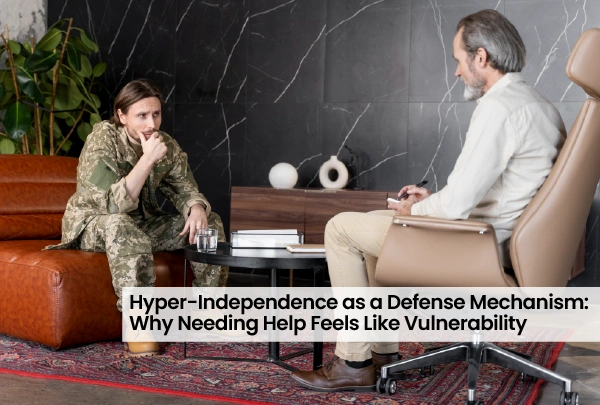
Being capable, self-reliant, and independent are generally healthy qualities. However, independence can become rigid when a person feels unable to trust others, delegate responsibilities, express needs, or accept support even when they are overwhelmed. This pattern is often described as hyper-independence. Although “hyper-independence” is widely used in popular mental health discussions, it is not a formal diagnosis. It is more useful to understand it as a possible coping pattern that may develop when relying on others has previously felt unsafe, disappointing, or emotionally costly.
For some people, doing everything alone creates a sense of safety and control. Asking for help, by contrast, can evoke discomfort, shame, fear, or a sense of weakness. Research on mental health help-seeking has found that self-reliance can be associated with more negative attitudes toward seeking professional treatment.
When Independence Becomes a Protective Pattern
Healthy independence involves knowing when to manage something yourself and when to reach out for support. Hyper-independence is different because the person may feel compelled to handle everything alone.
They might refuse assistance, avoid delegating tasks, minimise their own difficulties, or become uncomfortable when someone offers care. Even when they are worn out, they could say, “I can handle it.” Over time, this pattern can contribute to isolation and burnout.
The underlying belief may be less about strength and more about protection: “If I depend on someone, they can disappoint me,” or “If I need help, I will lose control.” Such beliefs can become especially strong when earlier experiences have taught a person that vulnerability is associated with criticism, rejection, neglect, or disappointment.
Why Vulnerability Can Feel Unsafe
Vulnerability requires a degree of trust. If someone has experienced emotional abuse, inconsistent caregiving, betrayal, or repeated invalidation, they may learn to protect themselves by becoming excessively self-sufficient. This does not mean that every independent person has experienced trauma, nor does it mean that hyper-independence always results from childhood adversity.
What matters is the function of the behaviour. If independence provides healthy confidence and flexibility, it can be adaptive. If it prevents a person from receiving appropriate support, forming close connections, or acknowledging genuine needs, it may be worth exploring. Mental health help-seeking research similarly shows that personal attitudes, stigma, and self-reliance can influence whether people seek professional care.
The Emotional Cost of Doing Everything Alone
Hyper-independence can initially feel empowering because it reduces reliance on others. However, constantly managing responsibilities without support can become emotionally exhausting.
A person may experience anxiety when circumstances are outside their control, because asking another person to help may feel risky. They may also experience anger when others fail to meet expectations, particularly if they have difficulty communicating their needs and instead expect themselves to manage everything.
Emotional suppression can further complicate the pattern. When difficult feelings are repeatedly ignored, people may struggle with emotion control, making emotional reactions seem sudden or disproportionate. The problem is not necessarily that they have “too many emotions,” but that they may have had limited opportunities to recognise, communicate, and regulate them safely.
How Hyper-Independence Can Affect Relationships
Close relationships require both autonomy and mutual dependence. Partners, friends, and family members need opportunities to give and receive support.
When someone consistently refuses help, others may interpret the behaviour as emotional distance or a lack of trust. The hyper-independent person, meanwhile, may feel that others are unreliable or insufficiently supportive. This can create a cycle: the person does not ask for help, others assume help is unnecessary, and the person becomes increasingly convinced that they must manage everything alone.
Consequently, relationship difficulties may develop even when the individual deeply values connection. Healthy dependence is not the opposite of independence. Being able to say, “I need support today,” while still maintaining personal responsibility, is an important part of secure and reciprocal relationships.
Recognising the Pattern
Self-reflection can begin with simple questions:
- Do I feel uncomfortable when someone offers to help me?
- Do I believe that needing support makes me weak?
- Do I avoid sharing problems until they become overwhelming?
- Do I find it easier to help others than to receive help?
- Do I become frustrated when people do not automatically recognise what I need?
- Do I equate being in control with being safe?
The purpose of these questions is not to label oneself. Instead, they can help identify patterns that may deserve further exploration.
Learning to Accept Support Gradually
Changing hyper-independent behaviour does not require suddenly becoming dependent on others. A healthier approach involves developing flexibility. A person might begin by accepting a small favour without immediately feeling obligated to repay it. They might delegate one task at work, tell a trusted friend when they are struggling, or ask a partner for practical assistance.
Goal setting can make this process more manageable. Small, measurable steps allow a person to practise receiving support while maintaining a sense of agency. This is also part of meaningful self-improvement: learning that strength can include knowing one’s limits, communicating needs, and allowing trustworthy people to contribute.
How Therapy Can Help
Therapy can help individuals examine the beliefs and experiences that maintain excessive self-reliance. Cognitive behaviour therapy can be useful for identifying automatic thoughts and examining beliefs such as “I must handle everything alone” or “If I ask for help, people will judge me.”
Dialectical behaviour therapy can also provide skills for emotional regulation, distress tolerance, interpersonal effectiveness, and mindfulness. These skills can help individuals communicate needs more effectively while maintaining healthy boundaries (Linehan, 1993).
Therapy does not aim to remove independence. Instead, the goal is greater flexibility: being capable of standing alone while also being comfortable leaning on appropriate sources of support.
When Professional Support May Be Helpful
Professional counselling can be particularly useful when excessive self-reliance contributes to persistent distress, isolation, emotional exhaustion, or difficulties in everyday functioning. Individuals searching for Best Psychologists in delhi, a therapist near me, a counsellor near me, or psychological counselling in delhi can consider the professional’s qualifications, experience, therapeutic approach, and expertise with their specific concerns.
Research also indicates that mental health literacy can influence attitudes toward psychological help, highlighting the importance of understanding what professional support involves (Cheng et al., 2018).
Conclusion
Independence becomes a problem not when a person enjoys being capable, but when they feel they have no choice except to handle everything alone. Hyper-independence may protect someone from the discomfort of vulnerability in the short term while creating loneliness, exhaustion, and disconnection over time.
To better understand patterns of excessive self-reliance, emotional avoidance, difficulty accepting support, and underlying psychological concerns, individuals who feel uncomfortable depending on others or expressing their needs can seek professional support at Psychowellness Center. Services are available in person at Dwarka and Janakpuri, New Delhi (Contact: 011-47039812 / 7827208707). With the guidance of experienced clinical psychologists and mental health professionals, psychological counselling can help individuals explore the experiences and beliefs contributing to hyper-independence, develop healthier emotional regulation and communication skills, strengthen interpersonal relationships, and gradually become more comfortable with appropriate vulnerability. Through personalised assessment and evidence-based therapeutic approaches, professionals can support individuals in recognising unhelpful coping patterns, building trust, setting healthy boundaries, and learning that seeking help can coexist with strength and autonomy, ultimately promoting emotional resilience, healthier relationships, and overall psychological well-being.
Mindfulness can help people pause before automatically responding to discomfort, making it easier to recognise the urge to handle everything alone. Practising mindfulness for greater focus, calmness, and emotional well-being may support self-awareness and a more balanced approach to vulnerability and accepting help.
Contributions: Dr. R.K. Suri, Clinical Psychologist, and Ms. Mahima, Counselling Psychologist
Frequently Asked Questions
- What is hyper-independence?
Hyper-independence is a coping pattern in which a person feels compelled to handle everything alone and finds it difficult to trust others, delegate responsibilities, or accept support. It is not a formal mental health diagnosis.
- Why does asking for help feel uncomfortable?
For some individuals, asking for help may trigger feelings of vulnerability, shame, fear, or loss of control. Previous experiences of rejection, criticism, disappointment, or emotional neglect may contribute to these feelings.
- How can hyper-independence affect relationships?
Consistently refusing help or avoiding emotional vulnerability can create distance in relationships. Partners, friends, or family members may feel excluded, while the individual may increasingly feel that they cannot rely on others.
- Can therapy help with hyper-independence?
Yes. Therapy can help individuals explore the beliefs and experiences underlying excessive self-reliance and develop healthier ways of communicating needs, accepting support, regulating emotions, and maintaining boundaries.
- Does accepting help mean losing independence?
No. Healthy independence includes knowing when to manage situations independently and when to seek appropriate support. Accepting help when needed can promote healthier relationships while preserving personal autonomy.
Call For Action
Individuals looking for professional psychological support to manage hyper-independence, emotional difficulties, relationship concerns, self-reliance, and challenges with accepting support may consider the services offered by Psychowellness Center. The clinic offers private, evidence-based mental health care and has convenient locations in Janakpuri and Dwarka Sec-17, Delhi. To book an appointment or learn more about the services, individuals can contact 011-47039812 or 7827208707.
References
- Cheng, H.-L., Wang, C., McDermott, R. C., Kridel, M., & Rislin, J. L. (2018). Self-stigma, mental health literacy, and attitudes toward seeking psychological help. Journal of Counseling & Development, 96(1), 64–74. https://doi.org/10.1002/jcad.12178
- Linehan, M. M. (1993). Cognitive-behavioral treatment of borderline personality disorder. Guilford Press.
- Schnyder, N., Panczak, R., Groth, N., & Schultze-Lutter, F. (2017). Association between mental health-related stigma and active help-seeking: Systematic review and meta-analysis. The British Journal of Psychiatry, 210(4), 261–268. https://doi.org/10.1192/bjp.bp.116.189464
- Vogel, D. L., Wade, N. G., & Hackler, A. H. (2013). Perceived public stigma and the willingness to seek counseling: The mediating roles of self-stigma and attitudes toward counseling. Journal of Counseling Psychology, 60(3), 379–386. https://doi.org/10.1037/a0033109