
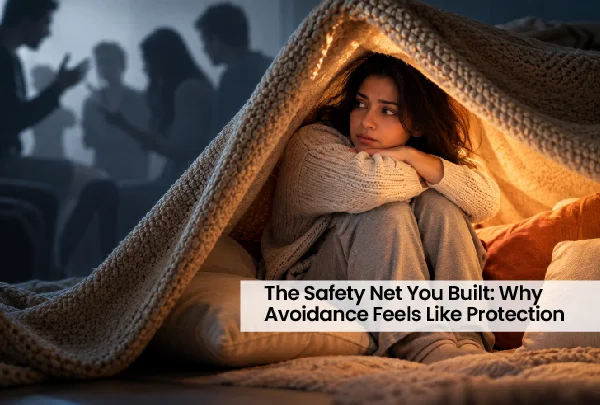
You put off the phone call, skipped the difficult conversation, or told yourself you would deal with it next week. For a moment, you felt lighter. That relief is real, and it is exactly why avoidance coping strategies are so hard to let go of. Avoidance feels like a safety net, but over time it can quietly trap you. This guide explains why avoiding problems works in the short term, what it costs you in the long term, and how to start facing things at a pace you can handle.
Why Does Avoiding Uncomfortable Situations Provide Temporary Relief?
Avoidance works because it removes discomfort fast. The moment you step away from something stressful, your body calms down, and your brain notes, “That worked.”
Why does avoiding problems make me feel temporarily better?
Your brain learns through reward, and relief is a powerful one. Psychologists call this negative reinforcement: when an action takes away something unpleasant, you become more likely to repeat it (Mowrer, 1951).
So the cycle looks like this:
- A situation triggers discomfort
- You avoid it
- The discomfort drops
- Your brain learns that avoiding is the solution
The relief is genuine, but it only lasts until the problem returns.
Why do we feel safer when we avoid difficult conversations?
Difficult conversations carry social risk: conflict, rejection, or disappointing someone. Avoiding them protects you from that risk right now, so it feels sensible.
For example, imagine someone who needs to tell a friend that a comment hurt. They say nothing, the tension eases, and they feel safe. But the hurt stays, and the friendship slowly changes.
How Does Fear Influence Your Avoidance Behaviour?
Fear is the engine behind most avoidance. It tells you something will go badly, and it is rarely precise. It sounds like “What if I say the wrong thing?”, “What if they get angry?”, or “What if I can’t cope?”
Fear also exaggerates. It makes the feared outcome seem likelier and the discomfort seem unbearable. Because you never test the situation, you never learn that you could have handled it.
Why do we procrastinate when something makes us anxious?
Procrastination is often not laziness. It is a mood-repair strategy. Research suggests people delay tasks to escape the negative feelings attached to them, giving short-term relief at a long-term cost (Sirois & Pychyl, 2013; Steel, 2007).
If a task triggers worry about failing or being judged, putting it off brings comfort. Then the deadline gets closer, and the worry grows.
How can we recognise unhealthy coping mechanisms?
Not all coping is harmful, but these patterns can signal avoidance that has gone too far:
- Constantly delaying tasks that matter to you
- Keep yourself occupied to avoid thinking or feeling
- Scrolling, gaming, or binge-watching to numb out
- Saying “I’m fine” when you aren’t
- Dodging certain people, places, or topics
- Using food, alcohol, or overworking to escape feelings
- Cancelling plans at the last minute
Ask yourself: “Is this helping me move forward, or only helping me not feel?” If it is the second, it is worth a closer look.
How Does Avoidance Create a Cycle of Anxiety and Fear?
Here is the catch: every time you avoid, you teach your brain the situation really was dangerous. The fear gets stronger, and the list of things you avoid grows.
Over time, this can shrink your life. Researchers describe this pattern as experiential avoidance, and it is linked to a range of emotional difficulties (Hayes et al., 1996).
How does emotional avoidance affect mental health?
When you push feelings away, they rarely disappear. They tend to show up in other forms: tension, irritability, poor sleep, or a general sense of dread.
The long-term effects can include:
- Rising worry that becomes harder to control, making emotional worry management feel impossible
- A flat or heavy mood, and difficulty managing persistent low moods
- Bottled-up frustration that leaks out suddenly, calling for anger regulation strategies rather than suppression
- Struggling with handling daily pressures, since small tasks pile up unfinished
Avoidance doesn’t remove the feeling. It merely delays it, frequently with enthusiasm.
How Does Avoidance Affect Your Personal and Professional Relationships?
Avoidance rarely stays private. Other people feel its effects, even when they don’t know the reason.
How does avoidance affect personal relationships?
In close relationships, avoidance can look like silence, changing the subject, or withdrawing when things get tense. Partners and friends may read this as not caring, even when you care deeply.
Common outcomes include:
- Small issues turning into large resentments
- Loved ones feeling shut out or unimportant
- Trust weakening because honest conversations never happen
- Emotional distance growing over time
What does it look like at work?
Professionally, avoidance can mean dodging feedback, missing deadlines, ignoring difficult colleagues, or never asking for help. Opportunities can slip by because you stayed in the safe zone.
A clear, calm limit can protect both your relationships and your energy. Establishing personal boundaries lets you say what you can and cannot do without hiding or running away.
How Can Gradual Exposure Help You Face Uncomfortable Situations?
Gradual exposure means facing what you fear in small, manageable steps, rather than all at once. It is a well-established approach in psychology, based on the idea that fear fades when you stay with a situation long enough to learn it is survivable (Foa & Kozak, 1986).
How can we stop using avoidance as a coping strategy?
Try this step-by-step approach:
- Name what you avoid. Write down the situations, conversations, or tasks you keep dodging.
- Rate each from 1 to 10 by how uncomfortable it feels.
- Start at the bottom. Choose something rated 2 or 3, like sending a short message you have been delaying.
- Stay with the discomfort. Notice it rise, peak, and fall without escaping.
- Repeat and climb. Move to harder items once the easier ones feel manageable.
- Reward yourself. Acknowledge each step, however small.
A few supports make this easier:
- Practising mindful awareness techniques: Notice the urge to avoid without acting on it. Name it (“this is avoidance”) and take three slow breaths.
- Emotional response regulation: Slow breathing, grounding through your senses, or a short walk can settle your body so you respond rather than react.
- Planning meaningful future targets: Connect each brave step to something you value, such as a closer friendship or a calmer career. A clear target makes the discomfort feel worth it.
Progress will be uneven. Some days you will avoid, and that is fine. What matters is the overall direction.
Conclusion
Avoidance is not a weakness. It is a smart short-term tool that stopped serving you once the costs grew bigger than the relief. By understanding why it feels safe, recognising how it shows up, and taking small steps toward what you fear, you can build a different kind of safety: the confidence that you can cope.
You don’t have to do this alone. At Psychowellness Centre, experienced professionals help you understand your avoidance patterns, ease anxiety, and build healthier ways to cope at a pace that feels safe. If avoidance is holding you back, reach out to Psychowellness Centre today and book a session to take your first step.
Contributed by: Dr. R.K. Suri, Clinical Psychologist, and Mr. Harshit Vaid, Counselling Psychologist
Frequently Asked Questions
Q1. What is avoidance behaviour in psychology?
Avoidance behaviour is any action taken to escape or prevent uncomfortable thoughts, feelings, or situations. It can be obvious, like skipping an event, or subtle, like distracting yourself whenever a difficult emotion appears.
Q2. Why does avoidance feel like protection?
Avoidance brings immediate relief, and the brain treats relief as proof that the avoided thing was dangerous. This makes it feel safe in the moment, even though it prevents you from learning that you could cope.
Q3. How does avoidance behaviour increase anxiety?
Each time you avoid, you reinforce the belief that the situation is unbearable. The fear grows stronger, you avoid more, and your sense of confidence shrinks, which keeps the anxiety cycle going.
Q4. Can counselling help overcome avoidance behaviour?
Yes. Counselling helps you identify what you avoid and why, understand the fear behind it, and practise facing it step by step with support. Approaches such as cognitive behavioural therapy and acceptance-based therapy are commonly used for this.
References
https://www.psychowellnesscenter.com/Blog/ways-to-handle-emotional-avoidance-and-long-term-distress/
https://www.psychowellnesscenter.com/Blog/soft-ghosting-the-new-face-of-emotional-avoidance/
https://www.psychowellnesscenter.com/Blog/are-you-healing-or-just-avoiding-your-problems/
Can Mindfulness Help You Face What You Avoid?
Foa, E. B., & Kozak, M. J. (1986). Emotional processing of fear: Exposure to corrective information. Psychological Bulletin, 99(1), 20–35. https://doi.org/10.1037/0033-2909.99.1.20
Hayes, S. C., Wilson, K. G., Gifford, E. V., Follette, V. M., & Strosahl, K. (1996). Experiential avoidance and behavioral disorders: A functional dimensional approach to diagnosis and treatment. Journal of Consulting and Clinical Psychology, 64(6), 1152–1168. https://doi.org/10.1037/0022-006X.64.6.1152
Mowrer, O. H. (1951). Two-factor learning theory: Summary and comment. Psychological Review, 58(5), 350–354. https://doi.org/10.1037/h0058956
Sirois, F. M., & Pychyl, T. A. (2013). Procrastination and the priority of short-term mood regulation: Consequences for future self. Social and Personality Psychology Compass, 7(2), 115–127. https://doi.org/10.1111/spc4.12011
Steel, P. (2007). The nature of procrastination: A meta-analytic and theoretical review of quintessential self-regulatory failure. Psychological Bulletin, 133(1), 65–94. https://doi.org/10.1037/0033-2909.133.1.65