
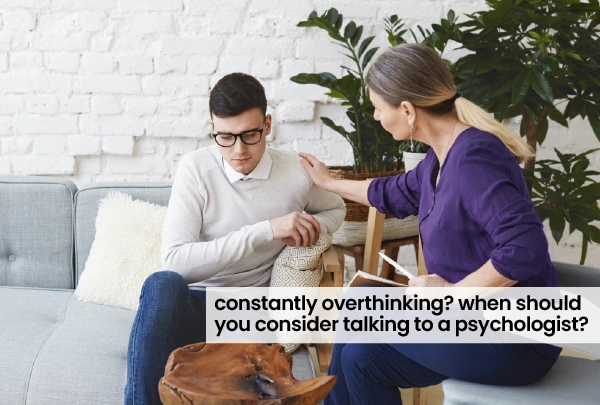
Have you ever replayed a conversation repeatedly, worried about something that might happen tomorrow, or spent hours thinking about a decision you have already made? Occasional overthinking is a common human experience. However, when repetitive thoughts become difficult to control and begin affecting your sleep, relationships, work, studies, or emotional well-being, they may deserve more attention.
Overthinking is sometimes a common human occurrence. It may take the form of rumination, where a person repeatedly focuses on past mistakes, negative experiences, or uncomfortable emotions, or worry, which is more focused on possible future problems. Both can become exhausting when they occur frequently.
What Does Constant Overthinking Look Like?
Overthinking is not simply “thinking too much.” It is often characterised by repetitive thought patterns that feel difficult to switch off. You may find yourself asking:
- “What if something goes wrong?”
- “Did I say the wrong thing?”
- “Why did I react that way?”
- “What do other people think about me?”
- “What if I make the wrong decision?”
- “Could I have handled things differently?”
The mind may continue searching for certainty even when there is no additional information available. Instead of helping you solve a problem, this cycle can increase doubt and emotional distress. Research and clinical guidance indicate that persistent worry can be associated with anxiety, difficulty concentrating, irritability, restlessness, sleep problems, and physical tension.
Why Do We Overthink?
There is no single reason why someone overthinks. It can develop in response to stress, uncertainty, difficult experiences, perfectionism, low self-confidence, relationship concerns, academic pressure, work-related expectations, or fear of making mistakes. For some individuals, experiences such as emotional abuse or prolonged loneliness may also contribute to repetitive and distressing thoughts.
For some people, overthinking becomes a learned coping strategy. They may believe that thinking through every possible outcome will protect them from disappointment or help them maintain control. Unfortunately, excessive analysis can sometimes create more uncertainty rather than reducing it.
For example, a student may spend hours worrying about an upcoming examination but find it difficult to concentrate on studying. Similarly, an adult may repeatedly analyse a conversation with a colleague or partner and become increasingly concerned about what the other person “really meant.”
When Does Overthinking Become a Concern?
Not every episode of excessive thinking requires professional intervention. The important question is whether it is interfering with your daily functioning. Persistent overthinking may sometimes be associated with concerns such as phobia, unresolved emotional experiences, or major life changes.
Consider talking to a psychologist if:
- Your thoughts feel difficult to control:- If you repeatedly try to stop thinking about something but your mind keeps returning to the same concern, professional support may help you understand the underlying pattern. Learning to manage anger and other strong emotions can also be helpful when they contribute to repetitive thinking.
- Your sleep is affected:- Going to bed but spending hours thinking, replaying conversations, anticipating problems, or worrying about the future can interfere with healthy sleep. Persistent sleep difficulties combined with excessive worry are worth discussing with a mental health professional.
- Overthinking affects your relationships:- You may constantly wonder whether someone is upset with you, interpret small changes in someone’s behavior negatively, or repeatedly seek reassurance. Over time, this can generate strain in relationships, particularly during major transitions such as divorce or marriage.
- It interferes with work or studies:- When excessive thinking makes it difficult to concentrate, complete tasks, make decisions, or remain productive, it may be time to seek support. Mental health professionals can help identify the thought patterns contributing to the difficulty.
- You experience physical symptoms:- Persistent anxiety can sometimes accompany symptoms such as muscle tension, headaches, fatigue, restlessness, sweating, or difficulty relaxing. These symptoms should not automatically be attributed to anxiety, and medical concerns should be evaluated appropriately.
- You are avoiding situations because of your thoughts:-If worrying about failure, embarrassment, judgment, or something going wrong causes you to avoid social situations, responsibilities, opportunities, or everyday activities, professional help can be valuable. Developing resilience can help individuals respond to uncertainty and difficult experiences more effectively.
How Can a Psychologist Help With Overthinking?
A psychologist does not simply tell you to “stop thinking.” Instead, therapy can help you understand why the thought cycle occurs and develop healthier ways of responding to it. Cognitive Behavioural Therapy (CBT), for example, helps individuals recognise automatic and unhelpful thinking patterns, evaluate the accuracy of those thoughts, understand their connection with emotions and behaviours, and develop more balanced responses. CBT is frequently used to address anxiety-related issues.
Therapy may also involve:
- Identifying common overthinking triggers
- Challenging catastrophic or all-or-nothing thinking
- Learning problem-solving skills
- Practising mindfulness and grounding
- Developing emotional regulation strategies
- Improving communication and assertiveness
- Building tolerance for uncertainty
- Developing healthier coping strategies
Eliminating all negative thoughts is not the aim. Everyone experiences unwanted or uncomfortable thoughts. The goal is to become better at recognising thoughts without automatically believing or reacting to them.
How to Find the Right Psychologist
When searching for the best psychologist near me, focus on qualifications, relevant experience, therapeutic approach, and whether you feel comfortable communicating with the professional. A good therapeutic relationship is important because therapy often involves discussing personal thoughts, emotions, and experiences. For children and adolescents, the approach should be age-appropriate. Parents may also consider looking for the best child psychologist in India when persistent worrying, reassurance-seeking, sleep problems, school difficulties, irritability, or emotional distress are affecting a child’s everyday life.
Families specifically looking for the Best Child Psychologist in Delhi NCR should consider a professional experienced in working with the child’s age group and presenting concerns. Parents can ask about the therapist’s qualifications, therapeutic approach, parent involvement, treatment goals, and how progress will be monitored.
What Can You Do Before Seeking Professional Help?
Small daily changes may support emotional well-being, although they should not replace professional care when symptoms are persistent or significantly impairing.
You can try:
- Writing down repetitive thoughts instead of continuously analysing them mentally.
- Separating problems you can act on from situations you cannot control.
- Practising slow breathing or mindfulness.
- Maintaining a consistent sleep routine.
- Taking regular physical activity breaks.
- Limiting excessive caffeine if it increases nervousness.
- Talking to someone you trust.
- Setting aside a limited “worry period” rather than allowing worries to occupy the entire day.
If stress or anxiety continues, interferes with everyday activities, or becomes difficult to manage independently, seeking professional support is appropriate.
Conclusion
There is nothing “wrong” with you if you overthink things. Sometimes, it reflects a mind attempting to make sense of uncertainty, protect you from mistakes, or prepare you for possible problems. However, when repetitive thoughts become exhausting and begin controlling your sleep, relationships, work, studies, or everyday choices, you do not have to manage them alone.
Talking to a psychologist can provide a safe and structured space to understand your thought patterns, develop practical coping strategies, and gradually build a healthier relationship with your thoughts. Asking for help is not a sign of weakness—it can be an important step toward greater emotional clarity and well-being.
Contributions: Dr. R.K. Suri, Clinical Psychologist, and Ms Tanu, Counselling Psychologist
Frequently Asked Questions (FAQs)
- Is overthinking a mental illness?
Overthinking itself is not necessarily a mental illness. It can occur during periods of stress or uncertainty. However, persistent excessive worry or rumination can occur alongside conditions such as anxiety or depression and may warrant professional assessment.
- How do I know if I need therapy for overthinking?
Consider therapy if your thoughts are difficult to control, occur frequently, disturb your sleep, affect concentration, interfere with relationships or responsibilities, or cause significant emotional distress.
- Can CBT help with overthinking?
Yes. CBT can help people identify automatic and unhelpful thoughts, examine whether those thoughts are accurate or useful, and develop healthier patterns of thinking and responding.
- Can children also overthink?
Yes. Children can experience excessive worrying about school, friendships, family, mistakes, health, or the future. Persistent worry may appear as reassurance-seeking, irritability, sleep difficulties, avoidance, or changes in school functioning. A child psychologist can assess the concern and recommend age-appropriate support.
- Will talking to a psychologist make overthinking disappear immediately?
Therapy is generally a process rather than an instant solution. A psychologist can help you understand the factors maintaining the thought cycle and teach strategies to manage it more effectively. Progress can vary depending on the individual and the nature of the concern.
Call For Action
If persistent overthinking is affecting your sleep, relationships, studies, work, or emotional well-being, seeking professional support can help you understand the underlying thought patterns and develop healthier coping strategies. Individuals seeking professional psychological support may consider the services offered by Psychowellness Center. With centres conveniently located in Janakpuri and Dwarka Sec-17, Delhi, the clinic provides confidential and evidence-based mental health care. To book an appointment or learn more about the services, individuals can contact 011-47039812 or 7827208707.
References
- American Psychiatric Association. (2025, August 8). Interventions for rumination: Breaking the cycle of negative thinking. Psychiatry.org. https://www.psychiatry.org/news-room/apa-blogs/interventions-for-rumination-breaking-the-cycle
- National Institute of Mental Health. (2024). Generalized anxiety disorder: What you need to know. U.S. Department of Health and Human Services. https://www.nimh.nih.gov/health/publications/generalized-anxiety-disorder-gad
- National Institute of Mental Health. (2024). I’m so stressed out! Fact sheet. U.S. Department of Health and Human Services. https://www.nimh.nih.gov/health/publications/so-stressed-out-fact-sheet
- National Institute of Mental Health. (2024). Psychotherapies. U.S. Department of Health and Human Services. https://www.nimh.nih.gov/health/topics/psychotherapies
- Weir, K. (2026, March 25). Targeting perseveration to reduce distress. American Psychological Association. https://www.apa.org/topics/psychotherapy/perseveration-distress