
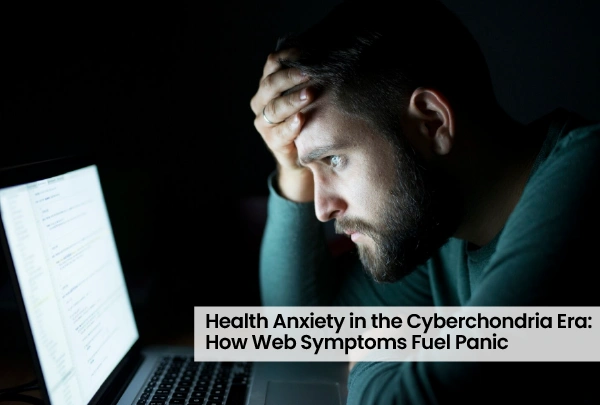
A mild headache. A brief episode of dizziness. A stomach ache that lasts a little longer than expected. For many people, the first response is no longer to wait, monitor the symptoms, or consult a healthcare professional; it’s to search the internet.
Within seconds, a simple symptom search can generate dozens of possible explanations, ranging from dehydration or fatigue to rare neurological disorders or life-threatening illnesses. What begins as a search for reassurance often ends with increased fear, racing thoughts, and an overwhelming urge to keep searching. This growing phenomenon is known as cyberchondria, a pattern in which excessive online health searches increase, rather than reduce, Health Anxiety and can eventually begin affecting both mental and physical health. Research consistently shows that people with higher levels of health anxiety often feel even more distressed after searching for symptoms online, creating a cycle that becomes difficult to break.
What Is Health Anxiety?
Health Anxiety involves excessive worry about having or developing a serious illness, even when medical evaluations are reassuring or symptoms are minor. Individuals may become highly alert to normal bodily sensations, frequently check their bodies for signs of illness, or repeatedly seek reassurance from doctors, loved ones, or the internet.
Importantly, the distress is very real. In some individuals, these persistent fears may overlap with Somatic Symptoms and Related Disorders, where health-related concerns become a major source of emotional distress. In the digital age, unlimited access to health information can unintentionally reinforce these fears instead of calming them.
When Searching for Answers Creates More Questions
Imagine noticing occasional chest discomfort after a stressful day. A quick online search may list muscle strain, acid reflux, stress, anxiety, heart disease, or several other conditions. Someone without significant health anxiety may read the information and move on. However, a person with heightened health anxiety may immediately focus on the most serious possibility and continue searching for more evidence to confirm their fears.
This repeated reassurance-seeking often provides only temporary relief before anxiety returns, leading to another search and another cycle of worry. Over time, cyberchondria can interfere with concentration, sleep, work, and overall quality of life. If this pattern becomes persistent, consulting a counselling psychologist in Delhi or seeking psychological counselling in Delhi can help individuals understand the anxiety behind these searches and develop healthier ways of responding to uncertainty.
The Cyberchondria Cycle – Why Online Searches Make Anxiety Worse
For many people, searching online begins with a simple goal: to feel reassured. Unfortunately, for those experiencing health anxiety, the opposite often happens. Instead of reducing worry, online symptom searches can intensify fear and create a self-perpetuating cycle known as cyberchondria. Research suggests that individuals with higher levels of health anxiety are more likely to feel more distressed after searching for health information online, leading them to search even more frequently.
The Cyberchondria Cycle
The cycle often unfolds like this:
Notice a symptom → Search online → Read worst-case scenarios → Anxiety increases → Seek more reassurance → Search again
Each search may provide temporary relief, but that reassurance rarely lasts. A new bodily sensation, another article, or a social media post about illness can quickly trigger fresh doubts. Over time, the brain becomes increasingly alert to normal bodily changes, interpreting them as signs of danger rather than ordinary experiences.
Why Does the Brain Focus on the Worst Possibility?
The human brain is naturally created to detect threats. From an evolutionary perspective, paying attention to danger helped our ancestors survive. Anxiety, however, can make this system overly sensitive.
Someone with health anxiety may:
- Focus on serious illnesses while overlooking more common explanations.
- Interpret normal sensations as evidence of disease.
- Continue searching until they find information that confirms their fears.
- Feel brief relief, only for anxiety to return again.
Psychologists refer to this as catastrophic thinking – the tendency to expect the worst despite limited evidence. The internet can unintentionally strengthen this pattern because search engines and symptom checkers often present a broad range of possibilities, including rare but severe conditions. In some individuals, this repeated reassurance-seeking may resemble patterns seen in OCD, where intrusive fears and compulsive checking reinforce one another, although cyberchondria is considered a separate phenomenon
When Reassurance Becomes Part of the Problem
Repeated symptom-checking may seem like a way to stay informed, but excessive reassurance-seeking often keeps anxiety alive. The more someone searches, the more uncertain they may feel, leading to another search in an attempt to gain certainty.
This growing pattern has become an increasingly recognized concern in psychological counselling in Delhi, where many individuals seek support not because of a medical condition, but because persistent worry about health begins affecting sleep, concentration, workplace, and relationships. Mental health professionals, including a counselling psychologist Delhi, often help individuals understand how thoughts, emotions, and online behaviours interact to maintain health anxiety, and how learning to tolerate uncertainty can gradually reduce fear.
This is why effective support is not about avoiding health information completely; it is about learning when information is useful and when repeated searching becomes part of the anxiety cycle itself.
Breaking the Cycle and Taking Back Control
The good news is that cyberchondria is treatable. The goal isn’t to stop caring about your health or avoid reliable medical information altogether; it’s to change the way you respond to uncertainty. Research shows that reducing compulsive online symptom searching and addressing the thoughts behind it can significantly lower both health anxiety and cyberchondria.
How to Break the Cycle
A few simple strategies can help reduce the urge to constantly search for symptoms:
- Pause before you search. Ask yourself whether you’re looking for information or simply seeking reassurance.
- Limit repeated symptom-checking. Reading multiple websites usually increases confusion rather than providing certainty.
- Challenge catastrophic thoughts. Instead of assuming the worst, consider more common and realistic explanations for your symptoms.
- Accept uncertainty. No online search can provide complete certainty about your health, and learning to tolerate uncertainty is an important part of recovery.
- Use reliable sources wisely. Trusted medical websites can provide general information, but they should never replace professional medical advice.
How Therapy Helps
When health anxiety begins interfering with daily life, evidence-based treatments such as Cognitive Behavioural Therapy (CBT) can be highly effective. CBT helps individuals recognize catastrophic thinking, reduce reassurance-seeking behaviours, and gradually become less fearful of normal bodily sensations. Studies have shown that treating health anxiety also leads to significant improvements in cyberchondria.
As awareness of cyberchondria continues to grow, psychological counselling in Delhi is increasingly helping individuals understand that the problem often lies not in the symptoms themselves, but in the cycle of fear, repeated online searching, and intolerance of uncertainty that keeps the anxiety alive. Take the first step toward better mental well-being with the Psychowellness Center. We offer evidence-based psychological counselling and therapy at our Janakpuri and Dwarka Sector-17 clinics. Contact 011-47039812 or 7827208707 to arrange a consultation.
Conclusion
The internet has made health information more accessible than ever before, but it has also made it easier to mistake information for diagnosis. While staying informed is valuable, repeatedly searching for reassurance can unintentionally fuel fear instead of easing it. Learning to question catastrophic thoughts, tolerate uncertainty, and seek guidance from qualified professionals when needed can help break the cycle. With the right strategies and support, it’s possible to develop a healthier relationship with both your health and the digital world.
If excessive symptom searching is increasing your anxiety or making it difficult to trust your health, seeking professional support can help. TalktoAngel offers online counselling, while Psychowellness Center provides evidence-based therapy to help individuals manage Health Anxiety, reduce cyberchondria, and improve overall well-being.
Contributions: Dr. R.K. Suri, Clinical Psychologist, and Ms. Ishita, Counselling Psychologist
References
https://www.psychowellnesscenter.com/service-anxiety-counselling-delhi/
https://www.psychowellnesscenter.com/Blog/demystifying-panic-attacks-and-anxiety-attacks/
https://www.psychowellnesscenter.com/Blog/lifestyle-self-care-strategies-to-manage-anxiety/
https://www.psychowellnesscenter.com/Blog/anxiety-recovery-formula-helpful-actions-to-be-taken/
https://www.psychowellnesscenter.com/Blog/fear-less-live-more-overcoming-phobias/
Newby, J. M., & McElroy, E. (2020). The impact of internet-delivered cognitive behavioural therapy for health anxiety on cyberchondria. Journal of Anxiety Disorders, 69, 102150. https://doi.org/10.1016/j.janxdis.2019.102150
Salkovskis, P. M., & Warwick, H. M. C. (1986). Morbid preoccupations, health anxiety and reassurance: A cognitive-behavioural approach to hypochondriasis. Behaviour Research and Therapy, 24(5), 597–602.